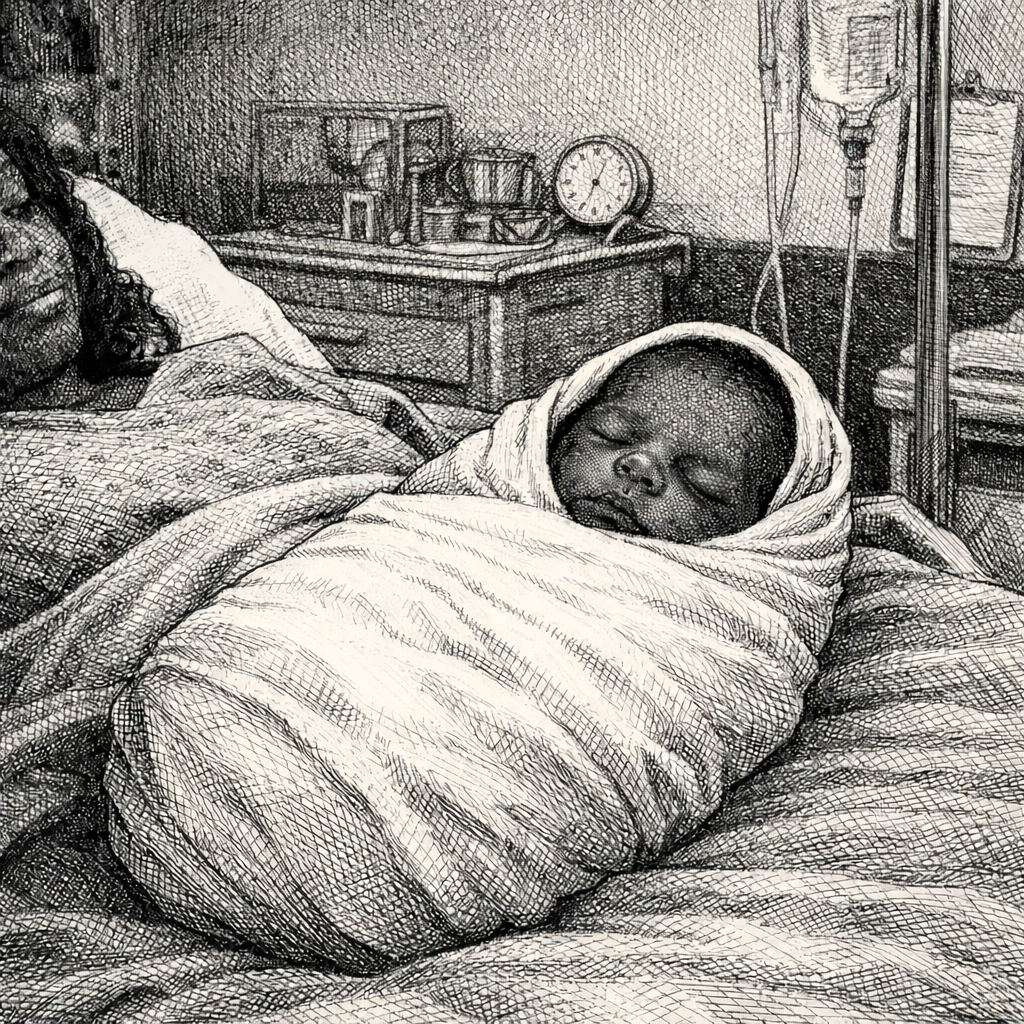
Grandma Lily was sweet, kind, and brilliant and still alive by the year Melvin Hawthorne was born; 1967 in the summer of love. As the opening credits of his life became instantly violent and the first person he would ever know forcibly evicted him, for the first time, she refused to comfort him when he wouldn’t stop crying.
“I can’t breathe,” Melvin thought and everyone heard even if they didn’t understand.
Dr. A. Villain, for his part, struck the newborn sharply on the bottom, and it hurt like a snap of cold air shooting into new lungs. Baby Boy’s first out-breath echoed through the cold rush of pain in a wail of anguish. Melvin Hawthorne was here and everyone felt his pain.
Melvin, who was named for his father, wasn’t necessarily born angry, but he was made angry soon after in the unconditioned air of the coloreds-only maternity ward located in a warehouse about a block away from Cook County’s whites-only facility.
“Boy,” Dr. A. announced, peering disapprovingly at his penis while delivering him dispassionately, and with all the disdain he had reserved for junkyard dogs. Colored is what they called him. Another Black boy was born howling in pain before the world could give him a name. Colored Boy was his.
“I need a drink!” is how anyone who heard him would translate the first sounds out of Melvin’s mouth, but no one in the room understood why.
“Melvin,” his mother answered, turning her head away in response to a question about names, and beginning a relationship built on rejection. She had done her part, and it had been more than enough.
Melvin was his father’s name, his father’s father’s name, and his father’s other son’s name from his father’s other family, who had also stolen his family name. The boy wasn’t drunk enough.
“I don’t care about my name, but I would very much like a drink if anyone’s buying,” Melvin thought.
They called him Melvin Williams but his last name would change officially several times before he reached the age of nine. Hawthorne was his great-grandmother’s maiden name, a name that had been given to her by the people who had raised her and enslaved her parents, her parents’ parents, and her parents’ parents’ parents’ before them.
“I don’t like Spam,” Melvin declared finally, forming new opinions as he breathed. “I don’t like you,” he said to the doctor. “And I don’t like you,” he added, pointing most of his fingers at the young white nurse. “And I don’t like Spam.” But no one understood him even as they understood that he did not like them.
Expired cans of old ham and shots of whiskey had induced early labor, when his mother no longer wanted to house the boy. Even though it wasn’t he who had eaten it, he could still taste it on his tongue. It tasted like an early eviction notice.
“I have rights!” he cried. “And I need a fucking drink.”
On his first day, Melvin was snatched from his home, rejected by a woman, and attacked by a coldhearted, costumed friend of his mother.
“This is a madhouse!” he wailed through new lips, new lungs, and cold air like needles against his new brown skin and everyone in the room was instantly pissed, but as far as Melvin knew, he had been annoyed his entire life.
The notorious Dr. A. Villain held him carefully but not lovingly, like a scientist who understood how precious a baby was but remained emotionally disconnected. He then proceeded to beat a him like a rock drummer playing a music festival in a racist town or an overseer on a cruel Louisiana plantation. Maybe not, but that was how it felt.
“It’s okay, Baby Boy,” a young girl told him. She turned to the doctor and said. “I can hold him. Give him to me.” The young girl named Beverly spoke as the doctor noted gender, race, and the time of birth on a piece of paper before the age of computers. His name was Melvin. He was male. He was black and he was bisexual. “He’s just a baby.” Beverly said. “Hand him here.” And the doctor did. To him, one black teenager was as good as the next. “Happy birthday, Melvin,” she added.
His mother’s friend, Beverly, had driven them to the hospital in her uncle’s Ford Transit and then they got back in the car when they were turned away because of overcrowding or because they were black. And young Beverly was the first person to show him love in the windy city, on the South Side, in the summer of love.
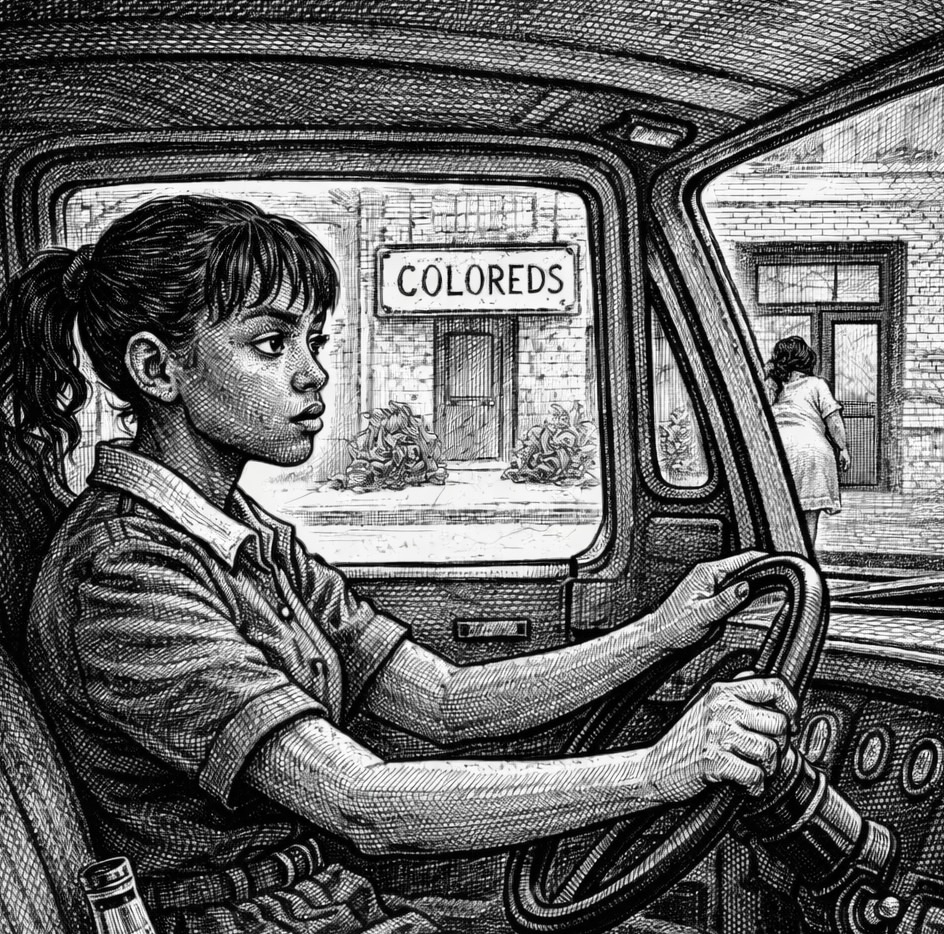
Melvin melted into Beverly’s warm embrace. A skinny little Black girl with yellow bows and ashen elbows offered the newborn baby his first real hug, and it was good and everyone knew how it felt.
It was a new warmth in a frigid world of absent fathers and mothers who couldn’t be bothered. Beverly’s big, beautiful heart beat just the right rhythm while Ella Fitzgerald sang about yellow baskets through a transistor radio’s single speaker at the nurse’s station.
“This is nice,” Melvin thought, suddenly tired. “I was cold and wet. I wanted a bourbon,” he complained silently to himself before nodding off. “Then I got attacked by a crazy guy in a white coat…”
Masked and gloved, Dr. A. fled the room like a villain, reaching for a cigarette and shoving it in his mouth as he went. He flicked twice on an old Zippo before the door had even closed, mumbling something about coloreds having too many babies and dashing through the EMPLOYEES ONLY double doors for a menthol-flavored break in a day full of action.
Nurse T. Unfriendly had tried to hand Melvin to his mother but found her surprisingly unwilling, so young Beverly—his mother’s best friend from high school—became Melvin’s first love and his first crush.
It was two weeks until senior year. Beverly had her license and her uncle’s minivan. Her best friend, Melvin’s Mother, had just had a baby, and she held firm to the anticipation of an epic senior year. However all that paled in comparison to the joy of listening to the deep, comfortable snoring of a brown-skinned baby boy. Beverly’s breathing bounced him beautifully against her breasts, and the worst of it was over.
Looking back on the day of his birth, Melvin had more than a few complaints: the doctor’s hands were cold. The doctor’s heart were cold. His mother’s rejection was cold. And unfortunately, there was no alcohol served because everyone involved in the birth was either currently at work or woefully underage, but I guess all’s well that ends well, at least that’s what his Grandma Lily used to say.
“There is balance in all things,” she told Melvin, age four, as she shuffled ingredients between her kitchen cabinets, her cherry lemon icebox, and an oversized kitchen table.
Lily grabbed a bowl, a wooden spoon, a ladle, two cans of lard, flour, sugar, and something called shortening, along with assortments of bitter chocolates, bacon bits, and previously shredded coconut in preparation for another magical and deliciously moist baked monstrosity she called German Chocolate Cake.
“Baking a cake takes precision, baby,” she instructed the four year old. “Everything must be measured, from the chocolate chips down to the number of candles on top.”
“Four!” Melvin yelled without looking up from his book.
“Is that right?” Lily asked facetiously, smiling devilishly but underappreciated.
“Yes, Ma’am,” Melvin replied, still focused on the pages of a large hardcover with very few pictures.
Melvin’s great-grandmother Lily lived well into her hundreds and died a robust and opinionated woman. She was a storyteller, a wiccan and a pastry chef that could show the boys in France a thing or two.
Lily was born into slavery just before the Civil War. She was the only daughter of domestic laborers whose masters had directed them to make more babies for the auction house. Slavery was big business right before it ended around 1893.
Grandma Lily loved baking and feeding her actively dwindling family. She outlived most of her children, all but her two youngest: Eleanor, the light of God, and Josephine, Melvin’s maternal grandmother, the coming darkness.
After more than a century of battles, bigotry and the bitterness that came with them, Lilith Elizabeth loved only two things: her comfortable kitchen lounge chair and her great-grandson. Her house had become a museum, with plastic-covered furniture and relics of African American history, including an old family Bible and an unabridged Oxford dictionary displayed on matching pedestals.
The last baby girl born indentured to the Hawthorne Sugar Plantation never stood for backtalk and was quick with a backhand, though she had never played tennis in her life.
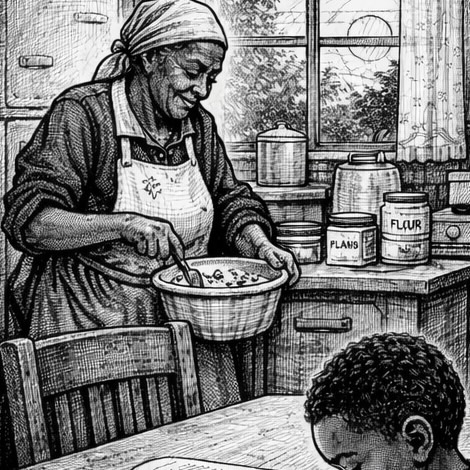
“This here is an old family recipe,” she continued in a low, raspy East Tennessee twang that demanded everyone’s full attention. “If we follow it religiously—”
“We get cake,” Melvin added.
“Don’t interrupt me.”
“Yes, Ma’am.”
Melvin sat on a tall chair at the end of the long table in his great-grandmother’s spacious kitchen while the centenarian matriarch, the living history of a once not-so-great nation, concocted creamy confections with layers of chocolate from Switzerland, Belgium, and Hershey, Pennsylvania.
Lily let her great grandson lick cake batter and frosting from spatulas and wooden spoons as if it were an essential part of the process. She transmitted tales of an extraordinarily long life through alarmingly loud false teeth that slid and clicked as she spoke.
“No,” Lily corrected him, wiping powder from the back of her hand onto the faded sunflowers of her denim apron. “We don’t make cake. We make batter.”
“Yummy,” Melvin intoned like an OM mantra, holding the final syllable until he was breathless.
“We pour it into pans and place it in the oven,” she said.
“Then we get cake.”
“No, Not yet. We need patience,” she corrected him, “And what did I say about interrupting?”
Melvin marveled at her immense presence without looking up at her earthen skin creased and marbleized by experience, struggle, triumph, love, and loss.
“I like cake,” he snapped.
“Patience, Pumpkin,” Lily said sweetly, moving within backhand distance of the boy. “Truth is, we might not ever get no cake. We could do everything right and still-” She leaned in, bringing smells of liniment, wheat, bacon, cocoa, and butterfat. “Something could go wrong, and then oops-” She kissed him on the cheek with lips that were both oddly wet and strangely dry.
“…no cake,” Melvin giggled turning the other cheek.
Lily wiped it and studied the competition for her attention. It was an intricate illustration in a book not meant for children, surrounded by pages of words too advanced for a four-year-old. The Adventures of Sherlock Holmes.
“Oops, no cake,” she echoed her last thought. “But we had fun, didn’t we?”
“Yes, Ma’am.”
“And we can always try again.”
“Yes, Ma’am.”
Lily’s great-grandson breathed his first few million breaths as she breathed her last few million. Through borrowed time, her patience and passion left a deep impression on the boy. Her final cakes tasted like a century’s worth of emotional resonance and kindness and family.
Melvin’s great-grandmother would eventually die in that kitchen, in her favorite chair, waiting for her last layer of chocolate cake to cool. And because the record-keeping for African Americans born into slavery was as unreliable Ford Transit, we may never know her exact age. Still, her final creation was as deep and delicious as her life.
Lily may well have been the last child born into slavery to die in the country that had enslaved her. She survived Reconstruction, Depression, and world war, burying every son she had given birth to. She saw the rise of the Klan and the Jim Crow South, yet lived long enough to see the children of enslaved Americans win the right to vote. I wished she cold have lived to see Obama but I’m so glad she didn’t live to see what came after.
The last light of the late-afternoon sun shone through the kitchen window from behind her head through pale kitchen curtains as the family’s monarch eclipsed even that fiery orb.
Two old friends formed a mandorla in the shape of a great and powerful African American witch but Melvin never saw it. He never took his eyes off the end table, the violin, the old revolver, the hung paintings, and the scattered clues in the illustration of the apartment at 221B Baker Street.
“I don’t like coconut,” he said suddenly. “It makes it hard to breathe.”
Lily stopped dead in her tracks. “That means you allergic, Pumpkin.” She was getting anger. “Does your mama know?”
Melvin nodded yes.
“Then why did she say to make you a German chocolate cake for your birthday? There’s coconut in it. She knows that.”
“That’s Mama’s favorite,” he said defiantly. “I can’t eat it. Not even the frosting.”
Lily paused. “I thought I was making you your favorite.”
“She isn’t very nice to me,” Melvin whispered.
“Not even on your birthday?”
“Not even,” he whispered.
Lily put a hand on his head. “We don’t get to choose our mamas, little one. God knows,” she told him. “Did she give you that book that you can’t read?”
“I can read it!” He said proudly. “It’s not like a picture book. There’s only like one drawing every ten pages.”
“But you can still read it?”
“Mm-hm.”
“My great-grandbaby is a genius. You using my dictionary for the words you don’t know?”
“Yes, Ma’am. Beverly taught me.”
“If they got words you don’t understand, you look ’em up.”
“Yes, Ma’am.”
“When is your mama coming back?”
“Tomorrow.”
“You mean she’s gonna miss your birthday?”
“Mm-hm. Beverly says she has to, and it ain’t her fault. Mama says it’s mine.”
Lily sighed, shifted her cane, and set up some clean pans beneath the window and the setting sun. “I’ll have to have a talk with that girl.” Melvin smiled, knowing full well what that meant. “But first, we gonna bake you a cake you can eat. What kind d’you want?”
“Vanilla.”
“Is that what Dr. Holmes like?”
“It’s SHERLOCK Holmes, Grandma Lily.”
“He ain’t no doctor?”
“No, Ma’am. He ain’t.”
“I thought he was a doctor.”
Grandma Lily started on another cake and another story as Melvin stared at the only picture he would see for another ten pages, a black and white illustration that brought the words to life.||
Be First to Comment