In the Book of Genesis, man is made flesh by God. In the Garden of Eden, woman is made from man’s bones—and it is she who gives birth to the rest of us. It is woman who bears the messiah, the offspring that crushes Satan. Western religion begins by granting creation to God, then quietly hands the responsibility to women, and spends the rest of history pretending that this was not a transfer of power.
Gnostic Christianity was spread through the Middle East by the women who witnessed Jesus’ death and were present for his resurrection. Mary, Mary and Miriam were the ones who stayed, who saw, who spoke. Later, they were edited out of the final cut by men who mistook authorship for authority and misogyny for divinity.
Hindu and Buddhist Tantra focus on the balance of spiritual energies—the union of Shiva and Shakti. Shakti is not a consort or an accessory but power itself: the divine force of the female body, the animating current without which even gods remain inert.
In many West African traditions, woman is the altar and man the sacrifice. Across North America, she is the base—the home and temple all return to. In Australian Aboriginal Dreaming, before colonial erasure, woman was Life Giver, Knowledge Keeper, Healer. From Afro-Caribbean mystics to Celtic druids, from Inuit and Viking to Inca and Zulu, the pattern repeats: woman as priestess, sorceress, source. Different names for the same truth on every continent.
In the beginning there was the word, and almost everyone’s first word is some version of mother. Ma. Mom. Ma’am. The first child to form the sound was likely asking for milk or for comfort, but the difference was only inflection. Language itself learned early what religion would later try to forget.
They say all magic starts with the mother, and Little Mei was no exception. Mei’s mother died in childbirth and, in dying, passed a generation of power into her daughter. She needed only to learn how to focus it—but at the moment, she was finding it hard to sit still, as if her body already knew this esoteric institution would be too small to contain her.
In the fall of 1923, a self-conscious Little Mei was surrounded by women in stiff cotton gowns of crimson, powder grey, saffron, and deepest black. Young girls and old, tall and short, with skin in every tone, filled the hall in robes. They were nuns of different faiths, gathered under one roof, bound less by doctrine and more by discipline.
From where she sat, Mei could see that the grand auditorium was packed with ancient, colorful things in red, silver, and gold—crosses, statues, candles—and beings unseen by others. Ghosts and gods. Phantoms and phantasms. Past masters and current teachers, all occupying the same merit field as the living.
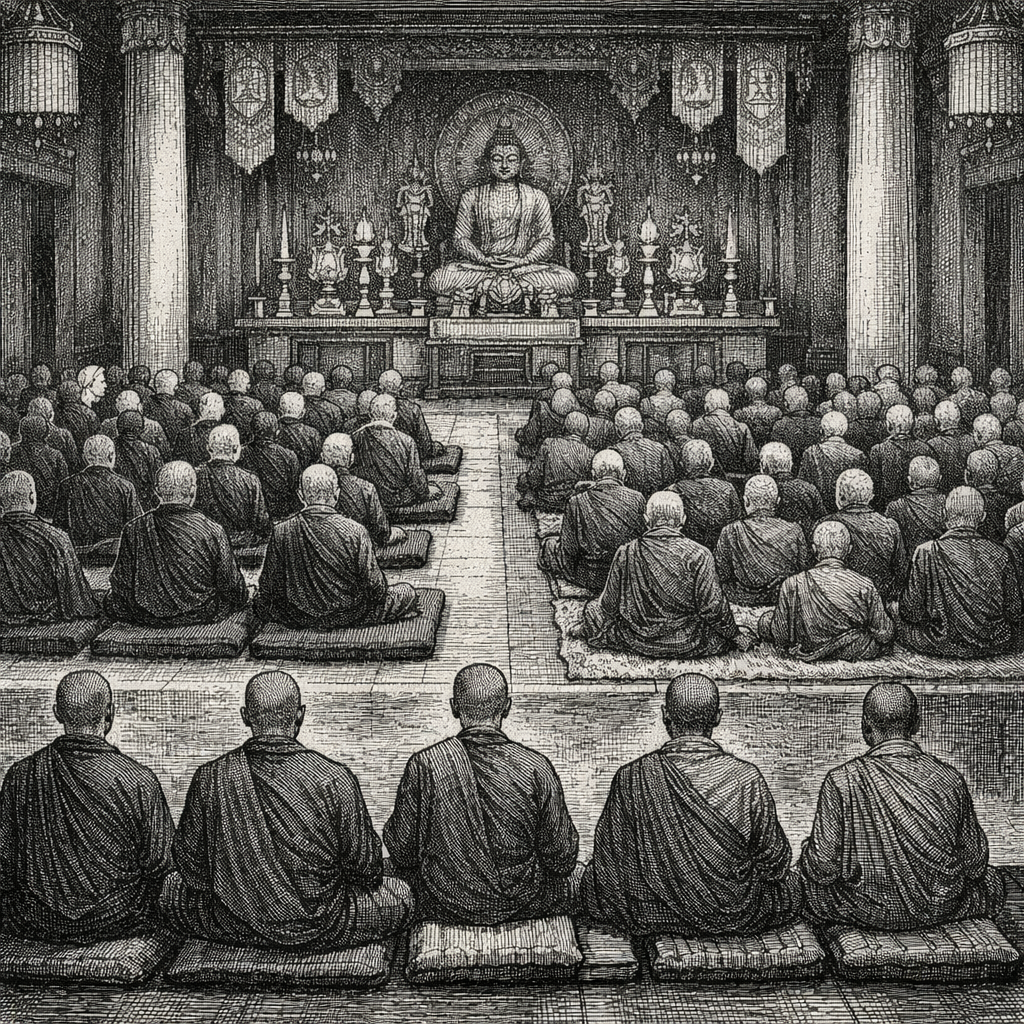
Freshly shaven heads filled the main meditation hall two by two. The normally locked side doors on the north and south walls were held open by wooden wedges, and nuns, like soldiers draped in silence, marched in evenly spaced lines, displaying each order’s discipline as a form of devotion.
By the south doors, a hidden passage led to a tunnel once used during war to hide the younger sisters away from invading armies. The north doors opened onto the kitchen and the orphanage and were rarely used, but today they stood open, admitting the nuns and laywomen whose labor kept the university grounds humming.
The main entrance, facing east, was reserved primarily for the men and the monks, except on holidays and formal ceremonies, when laypeople from nearby towns were allowed to file into the back of the hall—after the men and women of the cloth had already taken their seats.
Mei Lubaba entered the hall looking far more fidgety than usual. She was twenty-something and noticeably older than the other initiates. She had never seen this many apparitions in one place. She had never seen this many humans in one place either. She had only ever seen half this many yaks before, and even then they had room to move. The Buddha hall felt like a meadow full of yaks, packed in too tightly, but still calm and serene.
The University accepted only a handful of applicants from outside its own grounds, and each was required to pay a hefty tuition and demonstrate an aptitude for the arcane—proving both talent and access.
Shantideva University, on the island of Pain, in the archipelago of Shanqui Jian, was a seminary, a college of theology, a school for the talented and gifted—but beneath its stated purpose, it functioned as an administration of magic and meditation, careful about who it trained and even more careful about who it trusted.
Fourteen pieces of silver bought stiff monastic robes—two sets, both powder grey, itchy and uncomfortable—along with a towel, a blanket, and a cot. A novice paid for her meals through labor and for her education through negotiation, petitioning and the kindness of her teachers.
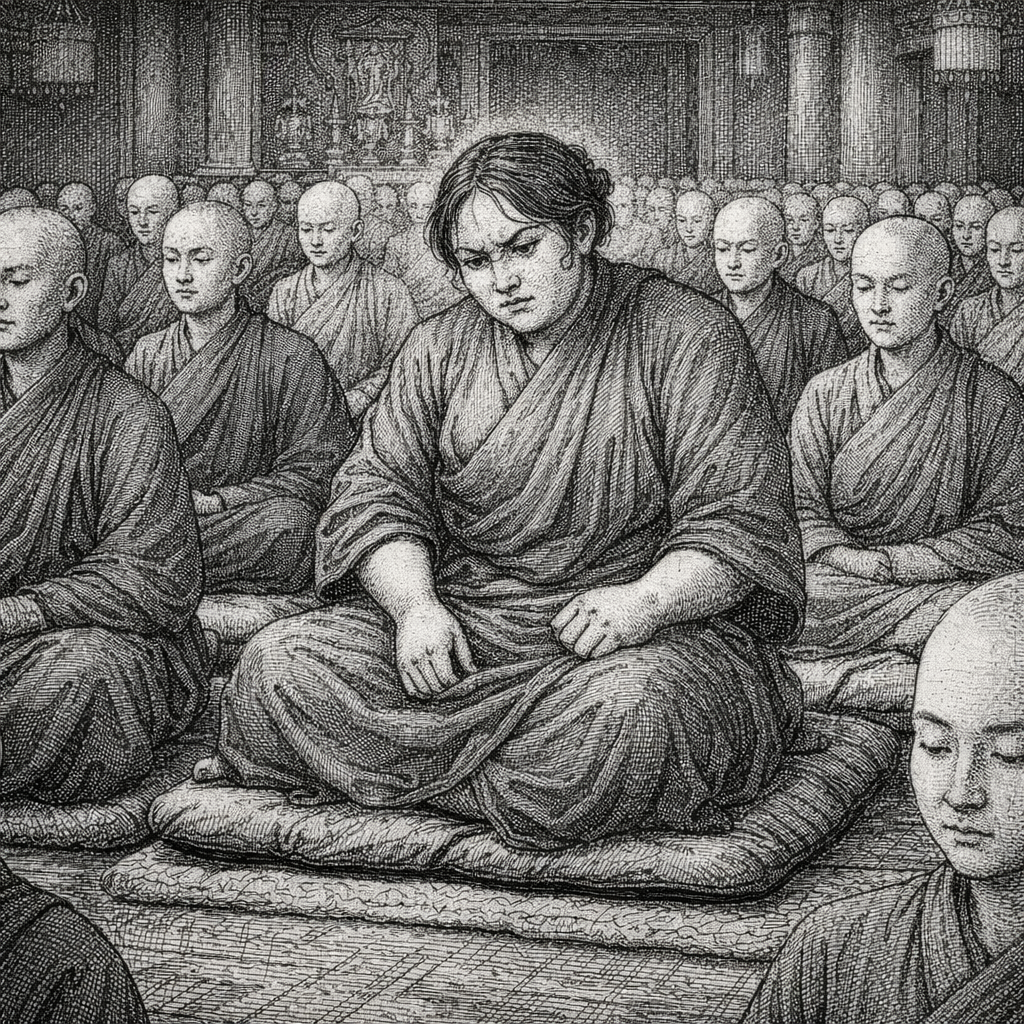
Mei had never noticed an elder nun smile, though in truth they smiled often—so often that their warmth had carved itself into the creases and wrinkles of their beautiful faces. Thirteen girls were joining the order that cold autumn morning, and none of them were as old, as uncomfortable, or as conspicuous as the big-boned farmer’s daughter who towered over the rest.
The older mothers, robed in various colors, regarded the younger initiates in matching grey with practiced compassion, blessing each by anointing her forehead with fragrant oils.
There were frowns of judgment on wizened brows—a preemptive disappointment born of years watching younger women make somber vows only to break them for marriage or madness. Yet when each of the mothers blessed Little Mei’s forehead, they smiled.
The fastest way to the university was through the orphanage and the nunnery. Many of the sisters had once been babies left on doorsteps with tuition paid in full, and the order accepted these abandoned girls as soon as they turned sixteen. Few possessed the innate ability of Little Mei.
Traditionally, nunneries of all faiths were the only viable option for women marked by scandal, injustice, or divorce.
Adult women came to monastic life by routes very different from the men’s. Men were said to have had a calling, and it was this—rather than cowardice—that excused their decision not to join the military: the army, the navy, the city guard.
Men were considered heroes for renouncing male privilege to don the androgynous robes of an ascetic—so long as they arrived with fourteen pieces of silver the discipline needed to keep vows.
Women outnumbered men at the university by a factor of three. Even so, the hall was divided evenly—men in the front, women tightly compressed like yaks in the back of the hall.
The female monastics did most of the cooking, cleaning, laundry, and construction across the university’s eight buildings: the main hall, the small hall, the nunnery, the orphanage, the main administrative building, the monks’ dormitories, the school itself and a massive industrial kitchen that served this elevated college town. There was also a farm nearby with several barns and grain silos.
Overlooking it all stood the capital city, home to the country’s political and religious leaders. At its heart was the palace, where the reincarnated king ruled—someone Mei had met when they were both children.
Beyond that, the rest of the island of Pain was a cold wilderness, forested and rising into snow-capped mountains at its highest elevations.
Monastic women cooked food, made clothing and cushions, and ran errands. They waited on their male counterparts, hand and foot. The men, for their part, studied, debated, meditated, passed ancient exams and rituals, and advanced in the tradition—supported at every step by the labor of the nuns.
The monks who occupied the front of the hall did not do so for lack of alternatives. They sat there because the system had been built with their bodies in mind.
It has been said that a man spends nearly an entire calendar month of his life waiting for a woman.
The system worked—so long as no one asked who it was working for.
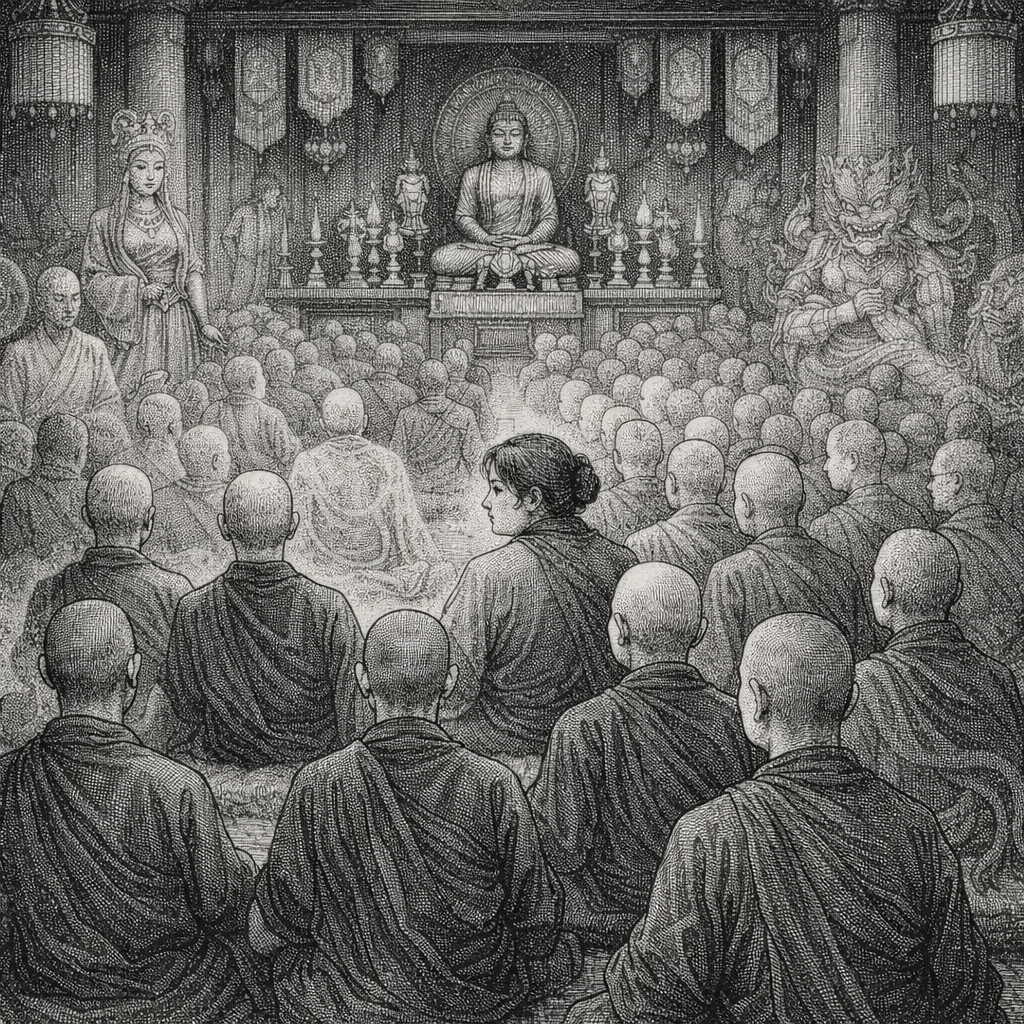
Ever since Mei was a child, she had been able to pierce the veil between realms and see the immaterial beings that no one else acknowledged were even there.
In the city, she saw hungry ghosts peering through restaurant windows, hauntingly envious of the diners within. She learned not to look at them.
She saw spirits waiting at the docks for loved ones who never returned from the sea. She learned not to let them know she could see them.
She saw demigods, devas, and titans walking triumphantly through crowded thoroughfares, regarding humans the way patrons regard animals at a wildlife preserve. She learned to respect their privacy and not to stare.
She learned to pretend in a nation that feared the esoteric power of women. She learned to perform powerlessness carefully. As a woman who was taller than most men she learned how not to bruise their fragile egos. For not only was she stronger physically but spiritually and she looked better in a robes.
In the hall, Mei could see the celestial bodies of former tenants—monks and nuns who had practiced there, and those who had died but never left. The building had stood for centuries and had collected long-term residents. Some of these souls would become her teachers, and when she stared, many stared back, sending shivers down her spine.
Mei struggled to adjust her new robes. Her skin itched like tree bark. She had been seated for barely a minute and her nose itched, and she was reasonably certain that she wasn’t supposed to scratch it, and no one else in the hall was fighting the same urge to smack her own face like she was. She told herself she would wait until the next break. She would scratch it properly then. Not now. Not yet. It would be embarrassing.
Without thinking, she reached up to scratch the tip of her nose. The motion lasted longer than she intended—longer, even, than she had been seated in meditation. If this were a game, she would have already lost.
Best two out of three, she thought.
The monks sat on cushions. The women sat on tri-folded blankets on the frigid floor, a detail that sparked another sensory revolt in Mei’s unruly mind. This, she decided, must be why enlightenment was so difficult.
She thought.
She thought.
Was I not supposed to be thinking? she wondered.
The wonder of thinking was thought, she thought, but then thought that she shouldn’t be thinking.
After a strenuous stretch of meditation that had lasted more than five minutes, there was a great deal of speaking, chanting, and a little bit singing in languages she did not yet speak—Latin and Tibetan, with some Japanese, Sanskrit, and Pali threaded through.
The ceremony lasted an hour, and Mei used the time to survey the other candidates. She wasn’t sure whether enlightenment was a competition, but she was planning to win.
The orphaned girls had not known the particular mix of privilege, pain, and panic that had shaped her early years. She may not have been the oldest novice to climb up from the walled city, but she noticed how disciplined the young ones were and marveled at how still they could remain.
“I bet none of these little snot-nosed townies ever got a personal visit from a goddess,” she reassured herself, just before a female voice inside her head said, Shhh. Quiet your mind. The voice was not her own. This is where you belong, it said. You’re home.
After the singing and chanting ended, she and the other new girls were welcomed into each of the five traditions. Initiates were anointed and baptized, forgiven and ordained. They took refuge vows and bodhisattva vows, then were led from the hall to a single room meant to house seventeen novices—cots for those who had paid, floor-strewn blankets for those on scholarship—in a space that comfortably held half that number.
Mei slept on one of the cots, against the wall and away from the single window. Her money, at least, had been well spent.
The next few days would be filled with haircuts, sweeping, chanting, polishing, and prostrations—prostrations and more prostrations. Apparently, humility was the first lesson.
Becca once said she could never be a nun because she loved her hair too much. Mei wished Rebecca were there now, if only to see her bald head and give her grief about it.
Mei Lubaba would eventually be given the name Ruth by the same elder nun who administered her lay vows, conducted her interview, sponsored her ordination, and took her money.
Mei “Ruth” Lubaba was assigned to the kitchen and the laundry room. She spent most of her time preparing and cooking meals, eating and cleaning up after meals, then cleaning and folding sheets and blankets between meals.
Breakfast led to lunch and then to dinner. After evening meditation came chanting, then a few hours of sleep before rising to prepare breakfast again.
One sarcastic monastic called it the trap in the path of service and repetition. Still, Mei found it soothing to be of use to something larger than herself, and it was a considerable step up from collecting protection money and doing dirty work for gangs in the walled city.
Laundry duty mainly consisted of bedding and towels, though the supply was constant. Novices were responsible for cleaning and maintaining their own robes. No woman was permitted to touch the soiled garments of a man.
One of the more than one hundred vows taken by female monastics was never to touch a male monk’s laundry.
There were numerous additional vows for women compared to the men, but the only vow given exclusively to male monastics was the vow not to eat after lunch.
Once the kitchens had been cleaned, man—created in the image of God—was still not trusted enough to make himself a sandwich.
According to myth, God made the earth, the animals, and man in a matter of days, and then made woman from man. After that, all anyone had to do was sit back and let the woman cook—but instead came the micromanagement, the blame, and the rules. That is where this story of magic and meditation begins. ||
Be First to Comment