“Forgive me, Great Mother, for I have sinned. It has been several lifetimes since my last confession.”
In 1839, before the First Opium War, the Shantideva University was the premier institution of syncretistic education in the known world, folding Christian and Buddhist faiths into its curriculum with a heavy focus on the esoteric.
“In my past lives, Mother, I have started wars that have murdered the innocent, written laws that have stolen from the destitute, and misrepresented my intentions in order to enslave my gracious hosts.”
The university’s multidisciplinary curriculum existed outside of the realms of politics and culture for centuries. However, all of the established religious bodies warned against its mixing of faiths and practices. Students and teachers still travelled from the edges of the Earth to instruct and to study at the school.
Most that tried did not make it. No one who completed the journey was turned away.
“I am ashamed to have coveted their lands, their possessions, and their good fortunes because I have fallen in love with their descendants.”
“And it is for this that you wish to be forgiven?”
“No.”
“No?!”
“For the things I did in the past I am already being punished. What I want to be forgiven for I have not yet done.”
After the war, the world seemed smaller and the trip less arduous. More students found their way to the shores of Shanqui Jian, to the gates of the monastery, the nunnery, and the university, but so did its enemies. Fear of invasion and of outside influences changed the school’s policies as politics and war became critical considerations. Traveling students found the gates closed and the shores unwelcoming.
“What is sanity?” the Great Mother asked. “Or better yet, what is insane?”
Rejected applicants lived and died on the streets of the walled city hoping to be reborn as future students, creating the proper mix of negative and positive karma for future entry. Prospective students required a royal invitation, enough silver coins or an unmistakable aptitude for the esoteric arts.
“It is willful ignorance,” the Great Mother said with anger. “It is a repeated thought or action that has only caused suffering in the past and a misguided belief that, without changing a thing, the next time would be different.”
“I am limited by this body. Isn’t there something I can do to be reborn a god?”
“The karmic system of transmigration isn’t fooled by empty acts of performative goodness,” the Mother explained. “No matter how good the acting is, a lie is a lie.”
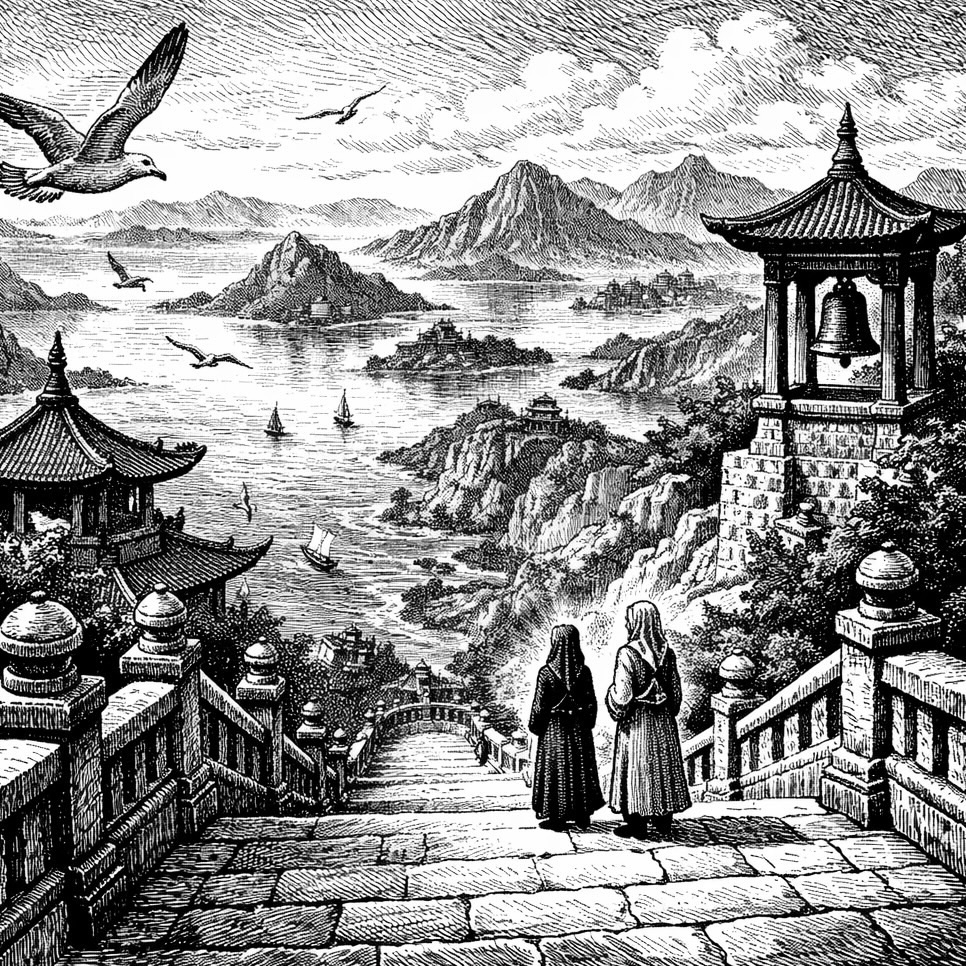
A century later, in 1939, Mei Lubaba, called Sister Ruth by her peers, still hadn’t confided with her sisters about her criminal past. Sister Ruth lied or implied untruths about her past violence. Without confession, she remained unrepentant and unforgiven.
There was blood on her hands and on the silver that paid her tuition. It took years of violence and criminal behavior by her shadowed self to mine that much silver, stolen from those who had stolen it. She used it to climb out of corruption and up the steep steps of redemption but it was a stain on her soul.
Mei was a murderer whose heinous activity and subsequent guilt had achieved for her the perfect mix of negative and positive karma with which to open the gates of Shantideva University.
“What is right or wrong?” Little Mei asked her holy sister, Somi. “What is sane vs insane? Are good and bad merely labels of intention or do they influence outcome?”
Djinn Somi, the novice nun who had captured Mei’s attention, earned her scholarship by defeating all three senior faculty members in the classical debate categories of Gnostic Christianity, Zen Poetry, and Tibetan Philosophy.
Somi was young, well-spoken and knew how to read people. She outsmarted the older, more learned monastics by catching them off guard with her sweetness, pleasant nature, and beauty only to surprise them with her intellect. But it wasn’t her intellect and her powers of oration that won her a spot. It was her ability to know when someone was lying.
Djinn Somi was a Korean novice who was far too fragile for this cruel world. She had a beautiful singing voice and had a way of putting everyone at ease. Her parents were devout Christians who believed in corporal punishment. Her father especially believed that the best learned lessons were accompanied by pain.
Somi was an avid reader and that was Little Mei’s type. She loved girls who loved words, and Djinn Somi loved words. The more exotic the better. Dead languages excited her most. No one had ever lied to her in a dead language.
Somi was a master debater because she could tell when an opponent’s words were simply a way to turn a clever phrase and not what they truly believed. It was that skill that opened the gates for her, but it also made her feel like a fraud.
Djinn Somi instantly knew when someone was lying, and when she was younger, it often triggered violence. Her family found her difficult to talk to because she could strike an unsuspecting person without warning.
Mother Chu once said that nothing in this world wasted more precious time than lies. Djinn Somi knew Little Mei was lying about something as the sister prompted her in front of the class.
“What is sanity?” Sister Somi repeated. The question didn’t come out of nowhere, and Somi answered it deliberately as if she had been preparing for the question her whole life.
“If living in vows feels right, then that is what is sane,” she said. “Or if living the life of a householder feels right, then that is what is sane.” She continued. “Sanity is the ability to do the thing that feels normal or feels right without questioning.”
“Are you saying that if someone questions whether or not they are doing the right thing that person is insane?”
“No,” she said. “We learn what is right through experience and example, but truly, the only thing that is insane is continuing to do something that you know is wrong because it seems easy.”
Mei had never had a sister. Though her classmates were called her sisters, they didn’t feel like family. The yaks on her farm felt more like family than her Shantideva sisterhood.
Sister Ruth spoke confidently. “So what you’re saying is if living the life of a homeless beggar feels right, then that can be your practice?”
“Until you find a better path,” Somi added. “Or maybe there isn’t one. I’m just saying that if it feels right, then you betray yourself by doing anything else.”
“And to betray yourself is insane?”
“Yes.”
“I agree.”
Sister Somi focused her attention on Ruth’s broad face and features for longer than was comfortable. She felt that the Sister must have been hiding something.
Somi only looked away when a seagull fluttered its wings against the glass. The islands were teeming with northern gulls. They gathered in the courtyards. They gossiped near the cliffside and flew above the spiraling walkway to the main hall below. They were not students but they audited every class with window access.
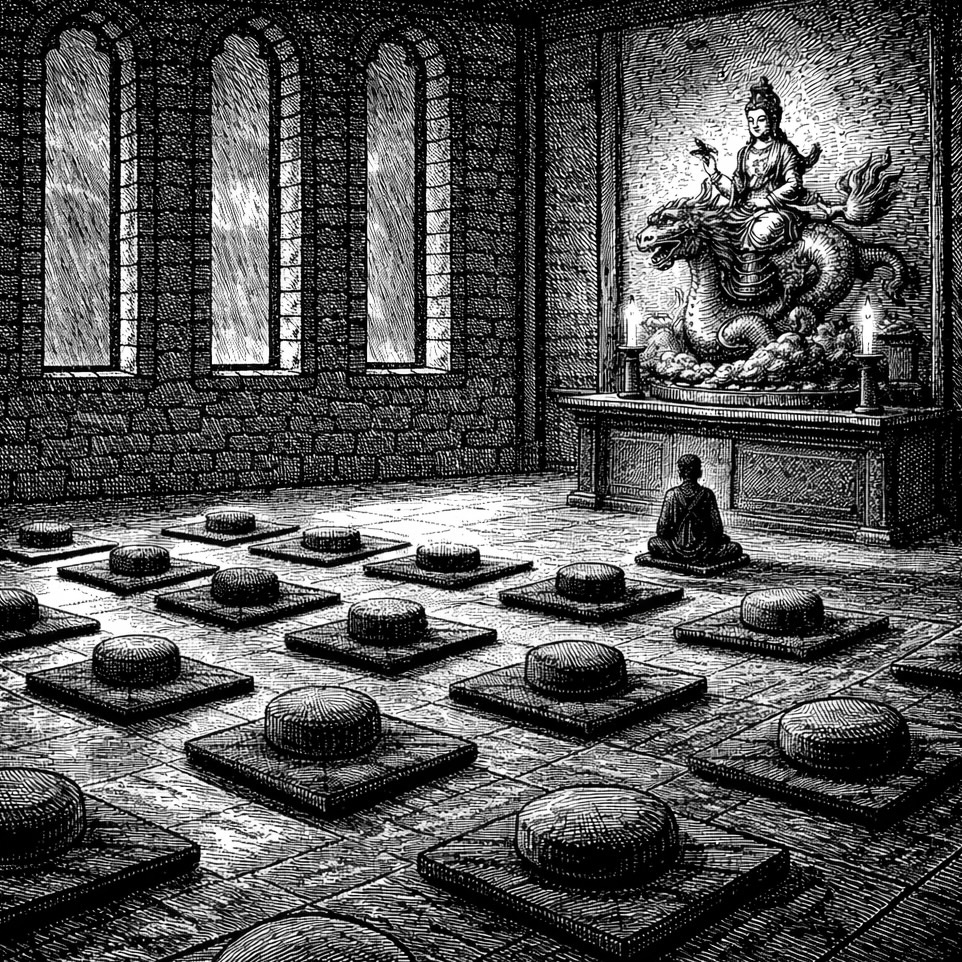
After the class, the two sisters were tasked with straightening the room, replacing the cushions and sweeping the dust, dirt, and leaves from the stone path that encircled the university’s main building.
A boisterous Northern Gull swooped down from the heavens and landed on the steps above the sisters and it voiced its frustration with the women. It had been watching them sweep and watching their obvious dance of forbidden desire but it was growing impatient.
The women were enthralled as it cawed and cawed out to them, expressing its disappointment with how long it was taking for them to finally kiss.
It was well-known that seagulls loved romance. You can find them at the beaches where lovers meet. They soar above the couples and the drama and eat small fish like buttered popcorn. Seagulls were students of the romantic arts but clearly did not understand the concept of vows or acceptable levels of audience participation.
“Kiss, kiss, kiss,” the bird whistled in an avian dialect. Both women had talents that were esoteric. But neither could understand, so it flew away.
Sister Ruth was a woman of action. She felt things deeply from when she was small. Though she wasn’t small for long.
Djinn Somi, on the other hand, expressed herself through words. Letting the tip of her pen or the tip of her tongue slide gracefully along the paper or the palette, forming word after word that was more than enough to make Mei want to kiss her.
Somi had tried her best never to lie because she didn’t like how it felt when people lied to her. She never once lied to Mei and likely never would. However, Mei lied to her all the time, and the sister could tell. Even her silence was a lie. The novice was the first to break the truce. She slapped the elder nun in the back of the head. Without whip, without cane, without instruction to do so, it was an abrupt, involuntarily violent action, the kind that she used to get in trouble for. An impulse she had controlled since childhood.
“What was that for?” Ruth asked her, even though she felt like she deserved it.
“With every sentient being that I see, from day to day,” the younger nun explained. “From the smallest seagull,” she motioned toward where the bird had been, that had complained about the pacing, “to the largest of the aquatic dragons, I have never had to pretend like I wasn’t completely in love with them all.”
Somi locked eyes with Ruth again, and they both half smiled, half grimaced, like four parts of a single expression of joy and suffering.
“I’m head over heels in love with them all,” she continued. “all of them,” she reiterated. “And I guess that’s my insanity.”
Somi’s labored breathing betrayed her nervousness, but her words continued unbroken.
“You can’t imagine how tiring it can get,” she admitted. “It’s like I’m falling in love and getting my heart broken every moment. I love both the seagulls and the dragons that eat them. That bird that flew away, I may never see her again, and it breaks my heart.”
Sister Ruth found it hard to breathe as the pretty young nun spoke. “I’m exhausted too,” she said with a melancholy smile as she turned away. A smile that faded just as quickly as the sisters parted.
They had strayed from their task too long, and each sister continued to sweep the dirt on their respective paths in opposite directions. It would be weeks before they spoke again.

Somi and Ruth never planned an encounter. The job assignments cycled irregularly. They each did nothing to change their fates. But when those fates put them in the same hall or room alone, sweeping or cleaning, chopping or peeling, setting up cushions or dusting the ceiling, these little encounters were like the sweetest butter cake fresh from the oven.
On a Friday afternoon, Sister Ruth headed down to the small temple for a scheduled weekend retreat. These were extended periods of meditation and reflection that superseded all chores and duties. Mei’s meditation teacher for this one was the Venerable Mother Chu.
Mother Chu gave lessons in single-pointed concentration. She called it a noble practice. Mei only knew it intellectually, without ever having experienced any realization. For her, it was all theory, no practice.
Mother Chu, had she not chosen to teach at this globally controversial institution of inclusive faith, would have been recognized as one of the world’s most respected meditation teachers.
Her method of attaining single-pointed concentration through inward stages of visualization was legendary. Even as Mother Chu’s three robes shouted humility and selflessness, the elder nun had a magnificent ego regarding her practice. Mother knew what worked, and she was proud of it.
There were two main meditation halls, the Buddha hall and the Bodhisattva hall, and Mei made her way to the smaller of the two grand temples. On the way she spotted Sister Somi in an antechamber with a bucket and a mop.
As a novice, Somi would serve as an attendant to the instructors for the weekend, supplying water, towels or blankets to the meditators between sessions. Soup, sugar water, or the occasional sharp, abrupt whipping or caning.
She was the carrot and the literal stick. She was the quenching of thirst and a pain in the back that brought the present moment into crisp sharp focus.
Unfortunately for Little Mei’s meditation practice, Somi had taken up residence in her mind, and would not leave. Seeing her before the retreat all but ensured her image would dominate among the obstacles to concentration.
Before the retreat began, Mei found a place to hide from her cushion to clear the young woman from her mind. A small chapel became her sanctuary. She kneeled, closed her eyes, and asked for help to get the novice out of her mind.
Jesus had temptations. Surely he could help with hers. His immediate answer startled her.
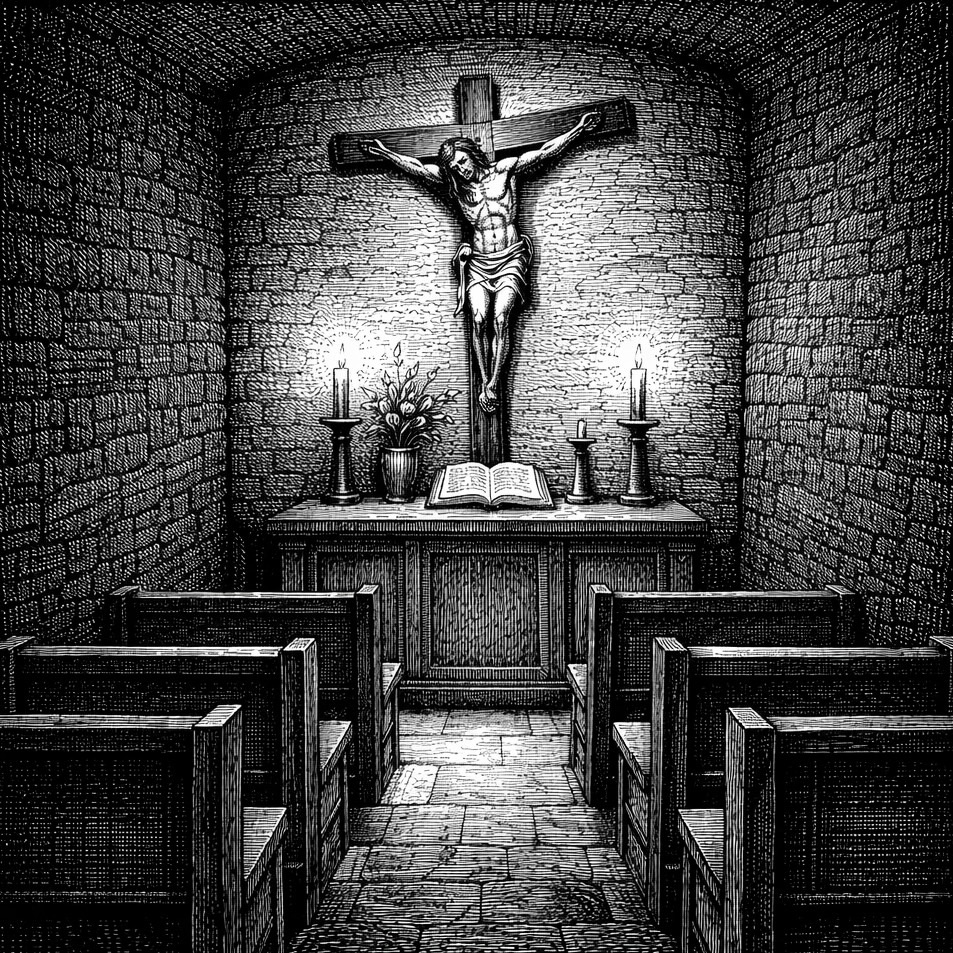
“Hear me, O lord, and have mercy upon me. Spare and restore me as I confess my faults and my past and future sins. My desire is full of suffering and my lies have become a way of life.”
Sister Somi found Ruth there in the tiny chapel, kneeling alone, and she knelt beside her. Father Miller, one of the senior priests of the university, always said that Jesus answers all prayers but we pretend we do not hear because we do not like the answer.
“We gather in the name of Jesus.” The young novice prayed beside her sister. “So that we are not alone.”
“I want you to know who I am,” Mei whispered as her sister listened through prayers of her own. “I used to be an enforcer for a street gang in Kabe Ichi.”
Somi prayed in a whisper as her sister continued. “O my God,” she said. “I am sorry for having offended you… lord.”
“I’ve learned so much since coming here,” Mei prayed. “But I don’t know if I belong. I feel like a fraud…”
“Not for fear of just punishments, lord,” Somi uttered in the space between her sister’s prayer. “But because I have offended someone who is good and deserving of love.”
Somi lightly smiled but never looked up, as the senior students could be heard shuffling softly past the chapel into the Bodhisattva hall for the retreat.
Mei swallowed hard and continued hesitantly. “I’ve committed the sin of murder,” she said. “I did it twice. They were thugs who would have killed me,” she explained. “But they were young and I never gave them a chance to change.”
Somi was not surprised by Mei’s confession. Her teachers always warned her that guilt pulled people to the practice. That just because they wear robes doesn’t mean they have always been good people.
“Animals.” Somi added in the silence and then sighed in relief as Ruth nodded her head.
They paused for a moment, and there was something unsaid, and then they both continued.
Mei admitted her fear. “I may never achieve perfect concentration because of my guilt.”
Somi whispered her hope. “I firmly resolve, with the help of your grace, to sin no more and to avoid the near occasion of sin.”
“I don’t think I deserve bliss or focus or you,” Mei said.
“It sounds like the universe is messing with you, Sister,” the young novice said. “Me too. We’ll just have to be better.”
“Amen,” Ruth said.
“Amen,” Somi agreed.
It suddenly started to rain.
This wasn’t a sign. It rained hard and it rained often at this elevation. It rained suddenly and it rained sideways. It rained for days or it rained for hours. It happened all the time. There was nothing magical about it.
“The rain is a sign,” Somi told her smiling. “A sign that you need to forgive yourself,” she said as the rain drummed hard against the stone walls of the chapel. “And as long as you’re being honest with yourself, nothing else matters. Your honesty is your sanity.”
“I always like running into you,” Mei told her, changing the subject as fast as the rain came. “I wish I would have known you when I was younger. I would have loved to have run through this storm with you.”
A tear graced Somi’s cheek as the rain poured and her elder sister’s heart poured out. Mei’s words of unrequited love touched her eardrums and beat syllables in time with Somi’s heart.
“I love thunderstorms,” Somi countered, slowly crying. “I love the rain in general. But I love a torrential downpour in particular,” she whispered.
“I love it best when you make it rain.”
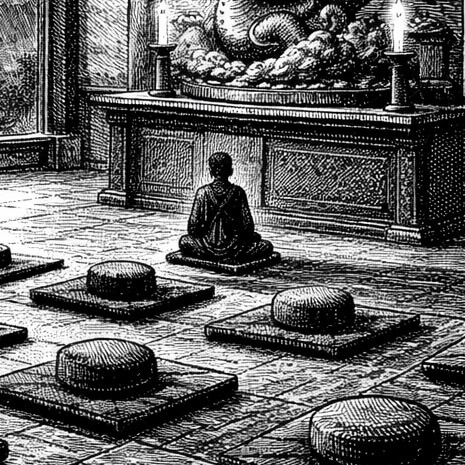
Little Mei’s tutor once told her that people in general become more human when it’s thundering and pouring. It’s a shared powerlessness that transcends class, race, gender or religion. Strangers huddle together under shelters to escape the deluge, with little room for revenge or mistrust.
Shelter from the storm is a universal desire shared by every living creature. A thunderstorm is a common enemy and a common fear, but for an empath like Somi, it was a vacation from the constant lies. A powerful storm set everyone beneath it on the path of honesty, the need for refuge.
Refuge was a powerful word that many of the teachers used. It was a word written in stone.
Somi found that most of her favorite, heavily loaded words in organized religion were written in stone or on scrolls. These fully loaded terms could not be translated accurately into any of the modern languages spoken in Shanqui Jian or the larger world. Faiths tended to find words they could agree upon that were close to the meaning and intention of ancient incantations in dead languages. Words that taught concepts like refuge, compassion, and emptiness at the university and beyond its walls.
Refuge, the English word, is not a perfect translation and imperfect translation was another form of lying. There were countless ways of saying the same thing. The citizens of the island nation, when conversing, chose the best term to describe their feelings or make their point from multiple ways of saying a similar thing.
Monks and nuns and practitioners from around the world recited various powerful words of inexact translation.
Poets, priests and professors were responsible for translating these stone words into something that their people could understand, but sometimes, with stone words, it took paragraphs, poems and pages of prose in modern languages that borrowed from ancient languages that borrowed from dead languages that were believed to be the language of gods. An accurately transmitted, scholarly translated but imprecisely defined meaning that would never be perfect and would always feel like a lie.
Refuge, in this case, was such a word.
In this context, it was a shared need to turn off the responsibilities, cut the power, kill the ego, and listen to the rain and the storm as it beat against the stone of the temple walls, the exact stones that built the borders of the walled city.
In this case, Refuge was a shared desire to feel the harmony that the storm created. It was a terrifyingly beautiful, destructive, and harmonic symphony for two or more.
In temples throughout human history, practitioners took refuge from the various storms of history together. This was their shared religion. It wasn’t the religion of Moses, Buddha, Jesus or their disciples that kept the world praying together but a religion of refuge.
Sister Ruth backed out of the chapel, bowed, and stepped through the small temple doors. She found a place for her cushion on the floor near the back before Mother Chu arrived.
While beyond the minds of mindfulness and the thunder and lightning that was like the applause and laughter of the gods, it was the universe that showed its sick sense of humor.
The universe mocked love as a rule. She had brought two souls together through a shared attraction, but bad timing. Two women from religions with vows that prevented them from being together.
How could they not think the universe was cold, cruel, and bitter? And the storm would last all weekend. The noise of it would remind the little girl that Sister Ruth used to be, Little Mei, of their stolen moments. Sister Somi’s face became an object of her meditation. Her love for the girl became a launching for her love of all sentient beings. The background noise of desire would not contribute to a lack of concentration but enhance it.
Amen.
Months after, Ruth knelt in the chapel they had shared. Between prayers, chores, classes and meditation there was little chance for Little Mei to relive that moment in the place where it happened.
There were tiny Christian chapels hidden in every corner of the university and the main building. Even in the orphanage, there were eight tiny chapels for prayer.
There were a little more than two billion people in the world in the mid-twentieth century and this was the place where she was forgiven by one of them.
The Great Mother addressed those two billion or so breathing souls. “Insanity,” she said, “much like the cycle of life, is repetition without change. If one does not want to suffer in this life or the next, then they will have to change.”
The Great Mother blessed us, every one, for she loved her children equally, and then she climbed back into the sky. ||
Comments are closed.