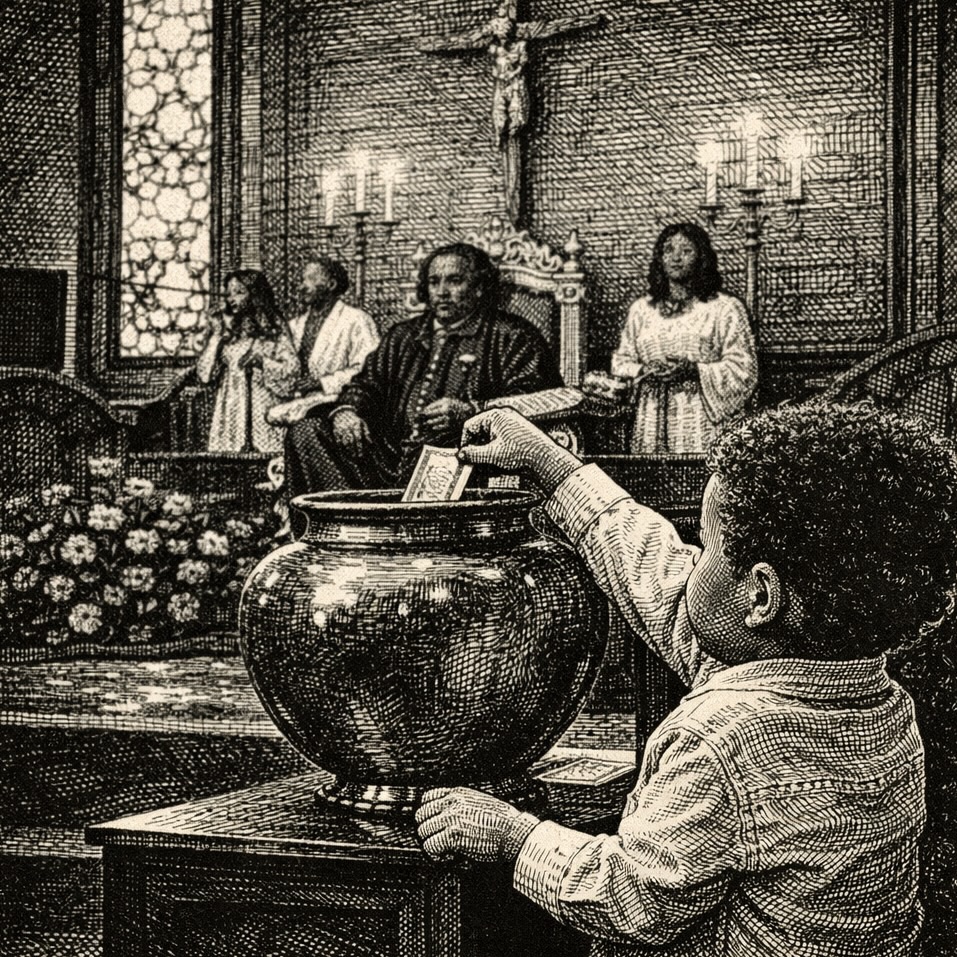
Eleanor folded at the waist to whisper to whisper in her grand-nephew’s ear on his sixth birthday. The church was packed with people, and the altar band was loud and joyous as petitioners danced in the aisles. She handed her grand-nephew a crisply creased one-hundred-dollar bill and said, “Drop it in the urn at the front of the altar. This is Pastor Tom’s money,” and then added, “Don’t let nobody see you.”
“Is it stealing?” Melvin asked her, having never held a bill of that size.
His Auntie Eleanor supported the pastor’s lifestyle, his wife’s, and his girlfriend’s. She gave the church ten percent of whatever she earned — but nobody needed to know her business.
Auntie Eleanor was a light-skinned Black woman with a closet full of hats, shoes, colorful Sunday dresses, and no children. She smuggled Melvin into Sunday services for his big day out while his mother was away. His mother had one rule: don’t take him to church. But she was never around on his birthday, so she had no say in the matter.
The previous year, Melvin’s uncle, the uncle who left him at a rock concert, took him to a rock concert for his fifth birthday. His mother had to come and get him from a sold-out arena in another state. His uncle who left him at a rock concert would never babysit him again. In fact, Melvin would never see him again. From then on, his mother’s oldest brother would be referred to as his uncle who left him at a rock concert.
Melvin’s mother always said that her eldest brother was a moron, but after leaving Melvin with her grandmother for his fourth birthday, and his grandmother for the first three, she felt she had no choice. Free childcare was, and always will be, another way of saying family.
His mother’s tradition was to leave Melvin with a babysitter on his birthday. Melvin would remark in later years how his mother had given him the gift of her absence. It was a present of her non-presence, a respite from the near-constant abuse she hurled his way, and he had never thanked her for it. How lucky he was that she wasn’t there.
His neglectful uncle took him to Gary, Indiana, from Chicago, Illinois, on a bus to a concert featuring James Brown and the Jackson Five — a family festival for his fifth birthday. Flip Wilson and Redd Foxx performed adult-themed stand-up routines while the children played sports and ate concert food in an open space outside the doors.
Melvin was never interested in sports. He wanted to see the show. Flip Wilson was his favorite comic. He liked seeing Flip dress up as Geraldine and shout about how the devil made him do it. He looked pretty in his makeup, and he made Melvin laugh. But kids weren’t allowed in during his show because he worked blue. Melvin didn’t like that he could only hear the laughter, and the occasional one-liner, when someone walked through the doors.
“No, Doobie,” Eleanor explained to him. “It’s the opposite of stealing. We’re giving, not taking.”
“Then why’s it secret, Auntie?”
“Because it ain’t nobody’s business what we do,” she said sharply. “Now go on.”
Auntie rolled her eyes toward the ornate ceiling of the grand cathedral, lit by the afternoon light through stained-glass windows that had cost thousands of dollars. Colored light danced along the thick wooden beams as the band played, the choir sang, and parishioners dug deep in their wallets to find the church’s money.
“Ain’t nothing to do with nobody what I give,” Eleanor said silently, as the faux-friendly faces of longtime rivals looked for weakness. She pulled a check from her purse, placed it atop the passing collection plate face-down, and faked a smiled back at them. These were her only friends.
At the altar, on center stage, under a ghastly wooden crucifix, a sweaty pastor with long, straightened hair sat slouched on a throne of laminated gold. He wiped his forehead with a gym towel and listened as the church band sang, “Oh, happy day. Oh, happy day. When Jesus washed my sins away.”
Melvin, age six, mumbled as he walked the center aisle to the front pew, past ushers and kneelers who refused to move. “Don’t talk back to your Auntie, boy,” he said in her voice. “Yes, ma’am,” he replied to himself.
His great-grandmother Lilith had two living children. Eleanor, the eldest, spent more time in Christ’s church than Jesus but that didn’t make her a Christian. She had a frenemies list as long as young Melvin’s leg, but had no ex and no children. Her younger sister had three. Eleanor did her best to help screw them up as well.
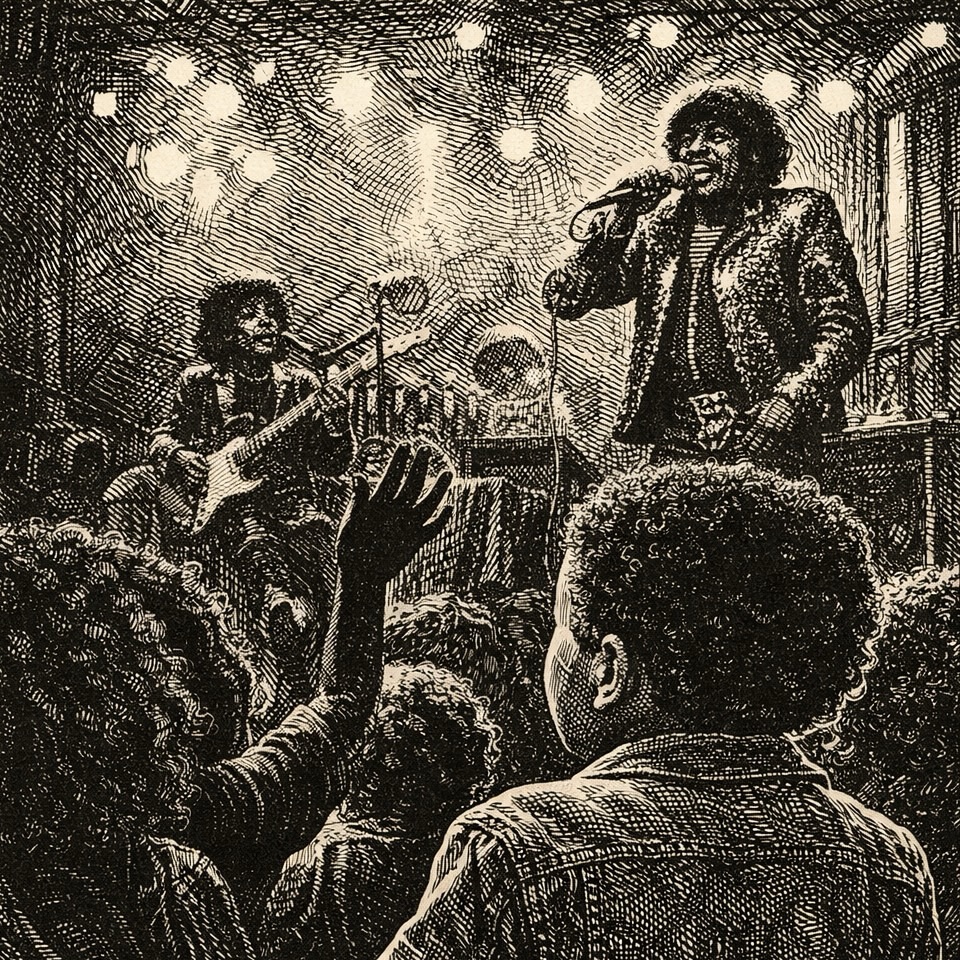
The arena doors opened before the Jackson Five took the stage, and the teenagers were allowed in. Melvin, age five, sat with his uncle and heard almost nothing from inside the auditorium. He heard Tito’s bass and Jermaine’s electric guitar, but as soon as Michael tried to sing, every girl, young woman, and excitable boy in the arena screamed as loud as they could. Melvin, who was very short but tall for his age, heard nothing but screaming. It made him so angry that he cried, and his enemies list now numbered in the thousands.
“These morons don’t want to hear the music. They just want to scream at the performer,” he thought. “They just came here to scream at Michael.”
“It ain’t Christian,” his Auntie had told him. “It ain’t Christian to spend your life caring what people think. They sinners anyway, and they think a lot of things that ain’t Christian to begin with.”
“Yes, ma’am.”
“They all going to hell in a handbasket,” she would say with a slight smile. “And that’s on God. Amen?”
“Amen.”
Melvin stumbled to the front of the church, stopping only to check his pocket to see if the important paper was still there. It was the most money he’d ever held. It had only been a few seconds since he had put it in his pocket, but things had a way of disappearing from there, so he held it in his hand.
The music in the church was loud, but the music in the arena wasn’t loud enough.
The Jackson Five left the stage to thunderous applause, and the screaming and the tears continued until James Brown was announced. He was the Godfather of Soul. He was the hardest-working man in show business. There were seven acknowledged wonders of the world, and Melvin was about to witness the eighth. He hoped to Jesus on the cross that there would be no screams. There weren’t.
The crowd was stunned into a funky silence as Melvin’s body rose above the arena, buoyed by a tremendous amount of cold sweat, heavy funk, and encores featuring Bootsy, Clyde, Maceo, and too many horns to count. It was raw — so raw that even Melvin, who barely knew what was going on, thought it was brilliant. It was a religious experience.
It was dangerous for a child to be exposed to such animalistic and sexual behavior. Melvin was too young, but it was too late. The floodgates had opened. He wanted more of this, and he would never be the same.
From then on, every time he walked into a room, it was an entrance, and when he left, there would be thunderous applause. Melvin lived his life on a stage as big as the world. He wanted to be talented, funny, and sexy. Deep down, he just wanted to be adored. At the very least, for people to shut up when his music played, drop a cape around his shoulders, and get the hell out of his way. He was a man who had places to be. But not really. He was five.
Melvin held God’s money in his tiny hand and aimed his uncomfortably tight shoes toward the altar. About ten feet from the front pew there were no more obstacles, and he began to tiptoe, exaggeratedly, like a mustache-twirling villain holding a hundred-dollar rent payment in a community-theater production of You Must Pay the Rent. Somewhere, there was a maiden tied to the train tracks.
Melvin thought he heard his Auntie let out a big sigh through her dentures as he approached the plate like a cartoon cat slowly creeping up on a sleeping dog. He got a laugh from the musicians as he dropped his payload into the pot and turned to give his Auntie a big thumbs-up. How’s that for stealth?
Eleanor held one hand to her head and shook it from side to side. “That wasn’t stealthy,” she told him as she pulled him back into his seat. “Do you want to be a clown all your life?”
“Yes, ma’am,” he said, knowing this was not the answer she wanted.
His uncle drank beer all day and hit on girls who were too hot, young, and smart for him. He left with a big-legged Black woman who had given him the time of day, and he couldn’t believe his luck. Melvin’s uncle left him inside the concert during the drum solo to go have bad sex in the parking lot. The guards wouldn’t let him back in. He was too drunk, and nobody believed he had come in with a kid.
Auntie Eleanor exhaled sharply. “Ain’t no child of mine gonna grow up to be no clown.”
Melvin didn’t only want to be a clown. He wanted to be a drag performer. He wanted to wear pretty dresses on stage and do comedy routines for people who would laugh. He would never tell anyone that his dream was for women to throw underwear, men to throw money, and everyone to adore him. He wanted to inspire people to dance and pray on their knees and light candles in his name. In short, he wanted to be the godfather of his very own religious cult.
Melvin’s mother never spoke his uncle’s name again. “The uncle who left you at a rock concert” was his name until he died falling down a steep staircase near his grandmother’s bar. She never mentioned either of her brothers by name. “The uncle who was killed by John Wayne Gacy” was what she called her younger brother after he disappeared, and that’s what she believed had happened to him. Melvin had two uncles, and he didn’t even remember learning their names.
“When you can’t sit still, those are them demons. Demons be messing with you, tickling your spine. Nothing a demon hates more than inactivity. They always want us doing something. Working in the fields, working in the kitchen. It doesn’t matter what it is. They want us active. They want us acting without thinking. They want us acting out of anger and passion — especially anger. But what they can’t abide is you sitting still. Thinking or listening. Demons hate that shit.”
“Ooooooooooh, you said a bad word.”
“Never mind that, sweetie. Your Auntie old. She can use bad words. I’m telling you, boy. They will mess with you, talk to you, tickle you – anything to get you to move. They want you to do something, but preferably something stupid that you can regret later. Woeful lamentation is the devil’s lullaby. Don’t let the devil make you act without thinking, because then that boy gonna make you double down.”
Eleanor dragged Melvin to a church service every Sunday she could, and only stopped when his mother moved them away. Josephine, her sister, went in the opposite direction. Lily’s youngest lived in darkness and would never step foot on holy ground. There were too many ghosts. Her children — the uncle who left him, the uncle who was killed, and the other one — were monumentally screwed up by having her as a mother.
Josephine was many things, most of them illegal. She was a dealer and an addict. She held a stake in a bar and managed hookers out of the alley in the back. She liked to gamble and had made a lot of enemies in her time. But according to the stories, her enemies had a way of disappearing.
Josephine was a registered psychic medium and empath. She read tarot and spoke for the dead. She could sense changes in the vibrational frequencies of the universe and suffered greatly from the pain it would cause.
Melvin was a neglected child of two worlds. Eleanor took him to church on Sunday and taught him how to hate and to judge. But Melvin and his mother lived upstairs from his grandmother’s bar. She had a much greater influence on him.
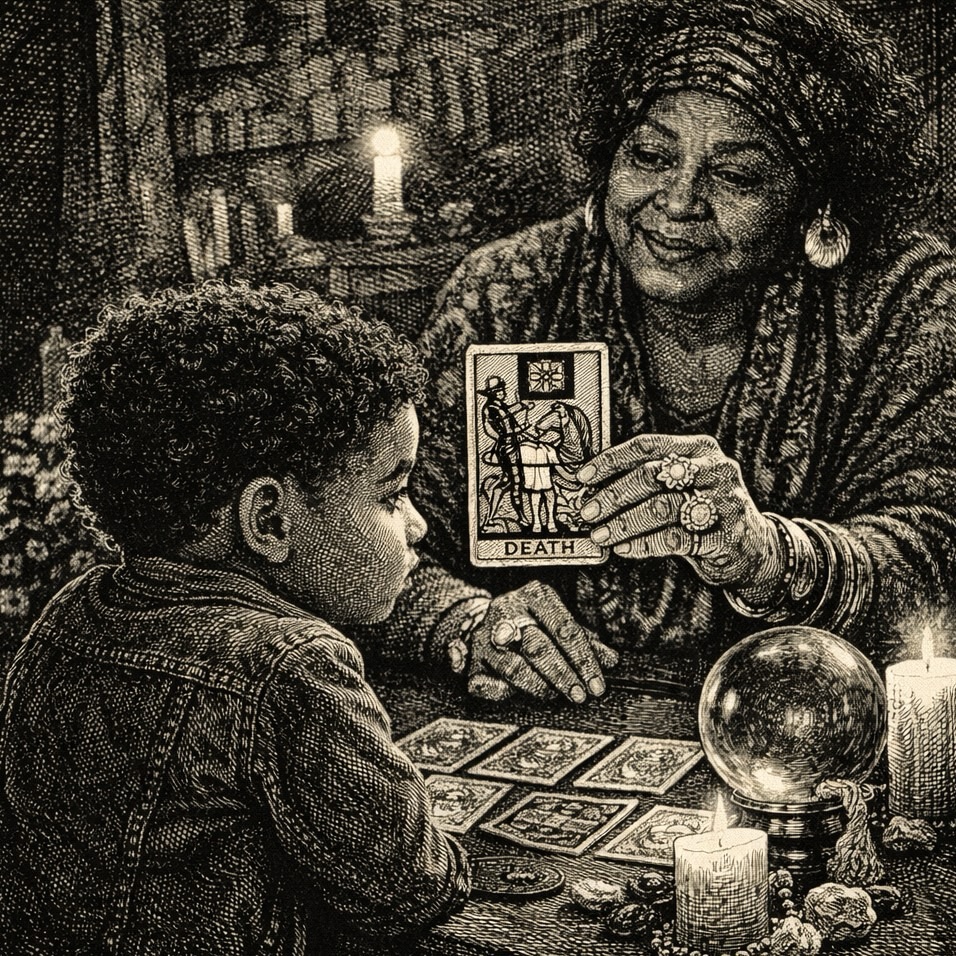
“When a spirit is present,” Josephine told him in one of her more lucid moments, “it feels like soda pop when it gets in your nose, but it’s all over your body like pins and needles.” Melvin, at age two or three, ate syrup sandwiches and pulled tarot cards for bar patrons until his grandmother died of an overdose a few years later.
Josephine showed him how loud, sharp sounds like bells, clapping, or even sneezing, and body convulsions like dancing, could chase away evil spirits, but they always came back.
“They drink soda?” Melvin asked with a giggle of self-satisfaction.
Josephine leaned back in her chair in the corner of the bar, knocked a bit of ash from her cigar into a worn pink ceramic ashtray, and blew a cloud of gray smoke not far enough away from her grandson’s face. “You know ghosts don’t drink no soda pop, boy. Stop playing.”
“I get bumps when we play cards,” he told her.
“Those are ghost bumps. You get them when a spirit passes through you. It ain’t nothing.”
“Auntie says it’s evil.”
“Don’t listen to my sister, Ella. That witch ain’t never had no man, so what does she know?”
Josephine had been married three times and stabbed five. “I’ll always be here to protect you,” she said. She wouldn’t.
Josephine couldn’t protect herself from an addiction that would eventually kill her. She used a needle to quiet the voices, and when that was in short supply, she would hide on the astral plane, or in the dreams of her grandson. She would project herself into his unconscious mind, but then forget why she was there.
“Don’t let them demons tell you what to do — but, honey, if they tell you not to do something, you need to stop. At least for a little while. You never wanna piss off a demon, sweetie. It ain’t no game.”
She had survived gang wars on the South Side after Capone and others had carved up the city. She had survived the racist leather biker gangs of the ’40s and ’50s, winning her little drug territory with her own blood. But still, she couldn’t navigate the astral plane for shit.
“Grandma Jo,” Melvin called to her after a nap. “You were in my dream.”
“In your dream, baby?” she humored him.
“Yes, Grandma. You were in my dream. What did you want?”
“I wanted a beer, baby. Bring me a beer.”
“You wanted me to go downstairs and get you a beer in my sleep?”
“I like beer when I wake up. Don’t judge me, boy. Just go get it.”
“Yes, ma’am.” ||
Be First to Comment