Sad, broken, and jostling without a seatbelt, Melvin Hawthorne left Chicago, Illinois, for Woodstock, New York, in the wee hours of the early morning.
“I don’t know what to tell you,” Miss Haddigood whispered to the ten-year-old Melvin Hawthorne in the low light of the art supply closet. It was late on a Thursday evening, and they were at school. They both belonged in bed.
Melvin shook with anger, and his teacher was close to tears, but the two huddled close so as not to be heard. This wasn’t seven minutes of heaven; it was seven minutes of heartbreak.
“No one will tell me the truth,” Melvin explained.
On weeknights, the elementary school was empty save for a small custodial staff, hard at work clearing the epic mess that a couple hundred students made in one school day. However, on this Thursday night, Miss Haddigood’s sixth-grade class was in session. There were two parents, two students, the vice principal, a sixth-grade teacher on the edge of panic, and a helicopter pilot. This was Woodstock, New York, in the fall of 1977.
“I don’t know what you want me to say,” the young teacher pleaded with her best student, her eyelashes about to burst. She didn’t want to cry. She didn’t want to show weakness in front of Alexander and his father. She had wanted to be an actor. She could cry on cue, but it was harder not to cry.
“You know I didn’t cheat,” Melvin whispered.
“You scored higher than Alexander, and that’s all that matters.”
Pretty Miss Haddigood usually spoke in a voice that was barely louder than a whisper when she addressed her class during normal school hours. Yet, almost instantly, every student in her fifth- and sixth-grade classrooms at Woodstock Elementary School found their seats or quieted down. She had a talent.
“Settle down, students.” Tessa Haddigood never raised her voice or her hand to a child. She wasn’t like the sadistic nuns in Melvin’s Catholic school, the ones who yelled and smacked the children with rulers and yardsticks.
She was blonde and pretty, and all the boys in Melvin’s grade had schoolboy crushes and goofy smiles when she spoke. She was friendly and perky and wore sundresses in the winter.
“Then why not make him take the test again?” Melvin asked, looking back toward the supply closet door to the room where the other adults awaited Melvin’s fate.
“I can’t do that,” Haddigood said through clenched teeth, like she had no choice.
Alexander’s father and namesake, Captain Alexander Bollinger, Sr., retired, had money and influence. Captain Bollinger owned half of the houses in the nearby towns and most of the stores. He dabbled in plastic, real estate, money management, and double-sided tape. His son walked through the village like royalty and was quietly being groomed for the Ivy League. We expect great things, they’d all say.
Alexander was a straight-A student at the top of his class. The best athlete. The best dresser. The best-looking. The wealthiest and loneliest kid in the greater Woodstock area. He got the best of everything.
He was the starting pitcher, quarterback, class president, and probably one of the sweetest little rich kids anyone could ever meet, if I were being honest, and he wasn’t trying to show off. Melvin had two schoolboy crushes, first boy and first girl. They were Shine and Alexander, but only when Alex wasn’t being a spoiled and entitled pain in the ass and Shine was still around.
All the trouble began when Melvin got the highest grade on a statewide test. Higher even than Captain Bollinger’s pride and joy. Alexander scored a 95. He answered 95 questions out of 100 correctly, while Melvin got a 98.
His teacher was despondent.
Melvin was told that he had to retake the test under supervision. They made him return that same night before the scores were made final.
“Is it because I’m black?” he asked.
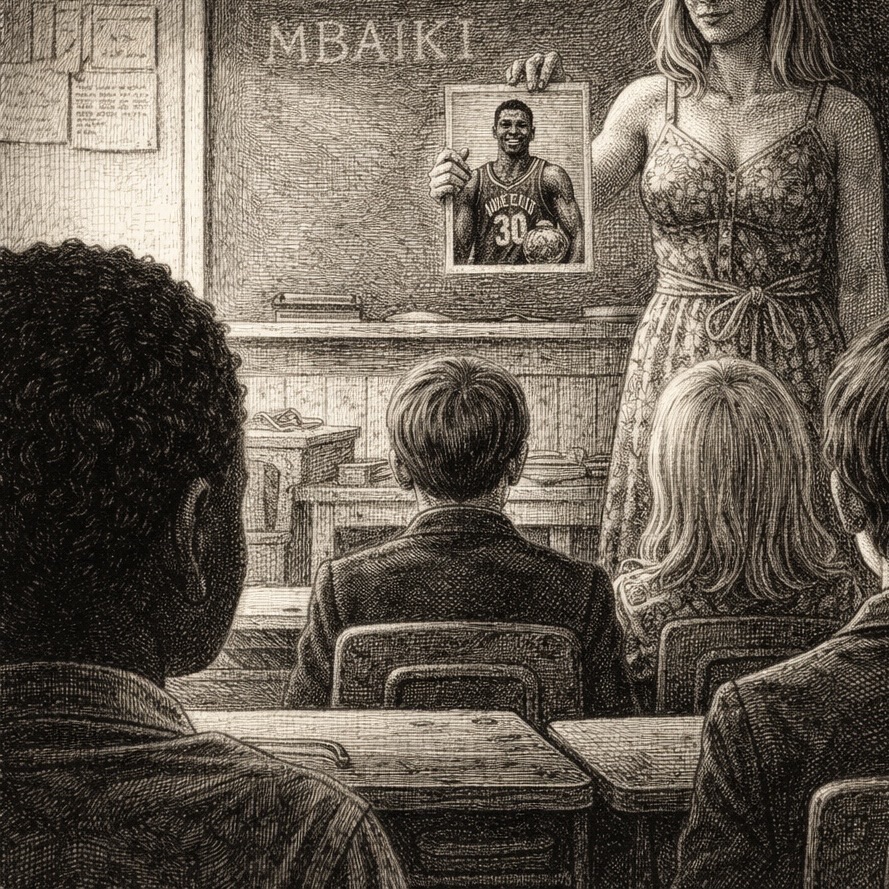
“Settle down,” she said. “Settle down” is what she told the class when she held a poster of a boy in an African tribal gown and the whole class burst into laughter. “This is Dikembe,” she said. “He lives in the village of Mbaiki.”
“Didn’t they get swallowed up by the sea, Miss Haddigood?” asked a young girl with lemon-yellow hair in the front row.
“No, Jennie, Mbaiki is in Central Africa,” her teacher told her. “You’re thinking of Shanqui Jian. And it wasn’t swallowed up. Shanqui Jian sank into the ocean after a series of volcanic eruptions. You may have seen it on the news.”
“Oh, right,” Jennie said, while her classmates reacted with sounds of amazement. The classrooms had a different feel in the daytime. The only reason a kid would want to be in school at night is if he’d broken in.
“And that was in Asia, Jennie,” Miss Haddigood told her, continuing the lesson about the African boy. “Dikembe is from Africa.” She knew very little about him and motioned with her left hand toward the only Black child in the class, Melvin. “Like Melvin’s people,” she added.
“I’m not from Africa,” Melvin said under his breath as she continued.
“Last year’s sixth-grade class collected canned food, toys, and clothing for Dikembe. We even built a playground in his backyard. This year, we’re going to top that by giving him the best Christmas ever,” she said. “Isn’t that right, students?”
“Yes, Miss Haddigood,” the class shouted in near unison, except for little Melvin, who was getting annoyed.
“Aren’t they Muslim?” he mumbled to himself.
Everyone’s favorite schoolteacher attached the photo of the African boy to the blackboard with a piece of masking tape that she grabbed from the art supply closet. She wanted to make the world seem smaller for her children, even if Melvin wasn’t cooperating.
“Is it because I’m black?” Melvin asked again in a hushed tone.
“No,” she said instinctively. “Yes,” she said apologetically. “I don’t know,” she said finally. “The man owns half the town. You scored higher than his son. If he says you have to retake the test, you have to retake the test.”
“This isn’t fair.”
“Life isn’t fair, Melvin,” she reminded him.
“Just tell them I didn’t cheat. You know I know this stuff. I’m smart.”
“Please, Melvin.”
“It’s Mel.”
“Please, Mel.”
“Tell me you want me to get one less answer than Alex got. Say it.”
“I can’t,” she said.
“But that’s what you want. That’s what everybody wants.” Melvin shuffled in place like a freshly caged tiger.
“Do you have to use the bathroom?” Miss Haddigood asked him.
“No,” the boy growled.
“Then do this for me,” she smiled. “And we can all go home.”
Alexander Senior paced the hallway like a shark, angry at everyone’s apparent confusion over what needed to be done. Alexander sat not in his assigned seat but in a chair near the back of the room. He had, up to this point, scored the highest grade at every level on every test. So how could this have happened?
In Melvin’s mind, it went something like this:
“Mr. Bollinger, sir. I’m sorry to bother you at this hour. There’s been an incident involving your son. I’m afraid it’s bad.”
“Oh my God. Did some Black kid score a higher grade on the statewide than my precious boy?”
“That’s right, sir.”
“I knew this day would come. Gas up the chopper. Find that little Black bastard and have him retake the test.”
Quietly embarrassed, Alexander formed pain-filled apologies with his mouth without making a sound every time the boys made eye contact. His father paced, and Melvin’s mother struggled to make the night all about her, but everyone ignored it.
What Melvin wanted everyone to remember most about that day was the two answers he got wrong. There was a question about electrical current and another about the scientific names for the parts of ants. The boy was a perfectionist. He reread those two chapters as soon as he got home, and when they said he had to retake the test, he was excited about it—until he learned why.
“How did his father even get the test scores?” Melvin asked.
“That’s not important.”
“What other grades have you faked… Tessa? What other thing should I have won that I didn’t?”
“It’s Miss Haddigood to you, son, and I don’t like your tone.”
Melvin had never seen her angry. She had disappointed him in the past, but never this bad. She was just misguided when it came to the subject of race.
She once tried to convince him that he and the African boy had so much more in common because of their skin color.
Misguided.
“Dikembe is ten years old, like you,” she said. This was wrong. Melvin was nine because he’d skipped a grade, but that wasn’t important. “He likes hanging with his bros, like you.” Melvin had no Black friends. He and his family were the only Black people in town. “He’s also different from you in a lot of ways.”
“Yeah, he’s poor.” A Hugo Boss blazer with a slicked-back do reminded everyone of his father’s net worth from his seat at the top of the class.
“That’s correct, Alexander,” Tessa Haddigood agreed sheepishly, then admonished the young man hesitantly, “but we don’t speak out of turn.”
The adult woman gave Alexander a moment to respond, and he turned forward in his chair, brushed lint from the lapel of his immaculately tailored jacket, sighed aggressively at her, and motioned with his tiny hand for her to continue.
Miss Haddigood spoke cheerfully. “Dikembe doesn’t have access to clean water or the newest games. He doesn’t get new clothes each season or the most fly gym shoes.” She held a broken piece of chalk and wrote words on the board with elegant strokes and graceful touches. “However, there are many more similarities between our classmates and Dikembe than there are differences. For example, he has favorite foods like you. He plays basketball with his friends like you. He prays to Jesus and loves his pets and his heroes like you—Muhammad Ali and Martin Luther King. Isn’t that right, Melvin?”
As the only Black student, Melvin was called on to sign off on any reference to African American culture, Caribbean culture, or African people in general. In the classroom, the gym, the playground, the theater, or during assemblies in the auditorium, white adults would constantly and annoyingly seek the approval of the only Black person they knew any time they mentioned anything remotely ethnic—something the one Jewish and the two Asian students knew all too well.
Melvin was ten. He had recently dislocated his shoulder and broken one of his orbital bones in a domestic dispute with his former stepmonster. When his favorite teacher mentioned Martin Luther King, it hurt him physically, as she would also need to acknowledge her white guilt for the way MLK was treated and smile at Melvin—perhaps even get him to respond.
“It’s Mel,” is all he said. It was Mel when she annoyed him.
Tessa Haddigood had once dreamed of Broadway stardom before she became a schoolteacher.
“Black,” Melvin countered as he stared at his teacher in disgust. “We’re both Black.” He said it knowing that particular similarity he and Dikembe shared alone. But it was exactly what she wanted to hear.

“What do you want to hear?” she pleaded with the boy.
“Does Alexander always get the highest grade because of his father?” Melvin pondered aloud. “And because it was a standardized test, you couldn’t cheat for him?”
“We’re getting off track,” his teacher said. “Focus.”
“How many times have I scored higher, but you helped him out because he was rich?”
“Please stop.”
“And white?”
“I’m going to lose my job,” she snarled quietly.
“This is wrong,” he answered.
“The world is wrong!” she barked defiantly. “The whole goddamn world. You’re Black. He’s white. You’re poor. He’s rich. I have one of the most important jobs on the planet, but I make next to nothing, and wealthy people make all the rules. Grow up.”
“Yes, ma’am,” he said automatically.
“Okay,” she sighed.
“And does it go on my permanent record that I cheated?”
“Yes,” she answered. “And we can all go back to being friends.”
“Friends?”
“Yes.” She smiled weakly, opened the closet door, and took her seat next to the other arbitrators of fairness and defenders of the status quo.
When Melvin left Chicago, he had a broken clavicle, a fractured orbital, and multiple bruises down the side of his back. It was the happiest day of his young life.
Alexander watched as Melvin raced through a test he had taken a few hours before on a Thursday night. No one congratulated Melvin as he scored a perfect 100 this time. It was not what they had wanted, but little Alexander thought it was awesome.
To him, it felt like a weight of perfection had been lifted from his shoulders.
Alexander’s dad shouted angrily at the Black boy who had defied him, “Why did you get more right?” He asked as if personally offended.
Melvin explained how he’d gone home and studied what he didn’t know the first time, and Alexander Senior stormed off with Junior close behind.
Friday morning, Miss Haddigood posted the test scores on the bulletin board, and next to Melvin’s name she put up his original score of 98. Not the perfect score he had earned through heartache and the soft bigotry of low expectations.
“You made me take it twice,” he grumbled.
Cold, cruel, and bitter, Melvin Hawthorne dropped into his seat at the front of the class. He wanted a perfect score.
Melvin’s eyes stared daggers at his former sweetheart. He didn’t participate in class. He didn’t raise his hand. He hardly moved, thinking only about how he’d gotten a perfect score—but no one knew.
The youngest, friendliest, sweetest teacher at Woodstock Elementary School assigned some light reading, rested her head on her desk, and cried.
Melvin, of course, took the blame.
Sally said Melvin was mean. Demian punched him in the back of the head. Jennie ordered him to stop making the teacher cry.
The sixth-grade class at Woodstock Elementary School had a new teacher the following Monday, and all the kids hated Melvin because of it.
In spite of it all, Miss Haddigood actually was a good teacher. Many of her lessons still resonated with Melvin, and he refused to throw the baby out with the bathwater.
She was right about one thing: life was unfair. ||
Be First to Comment