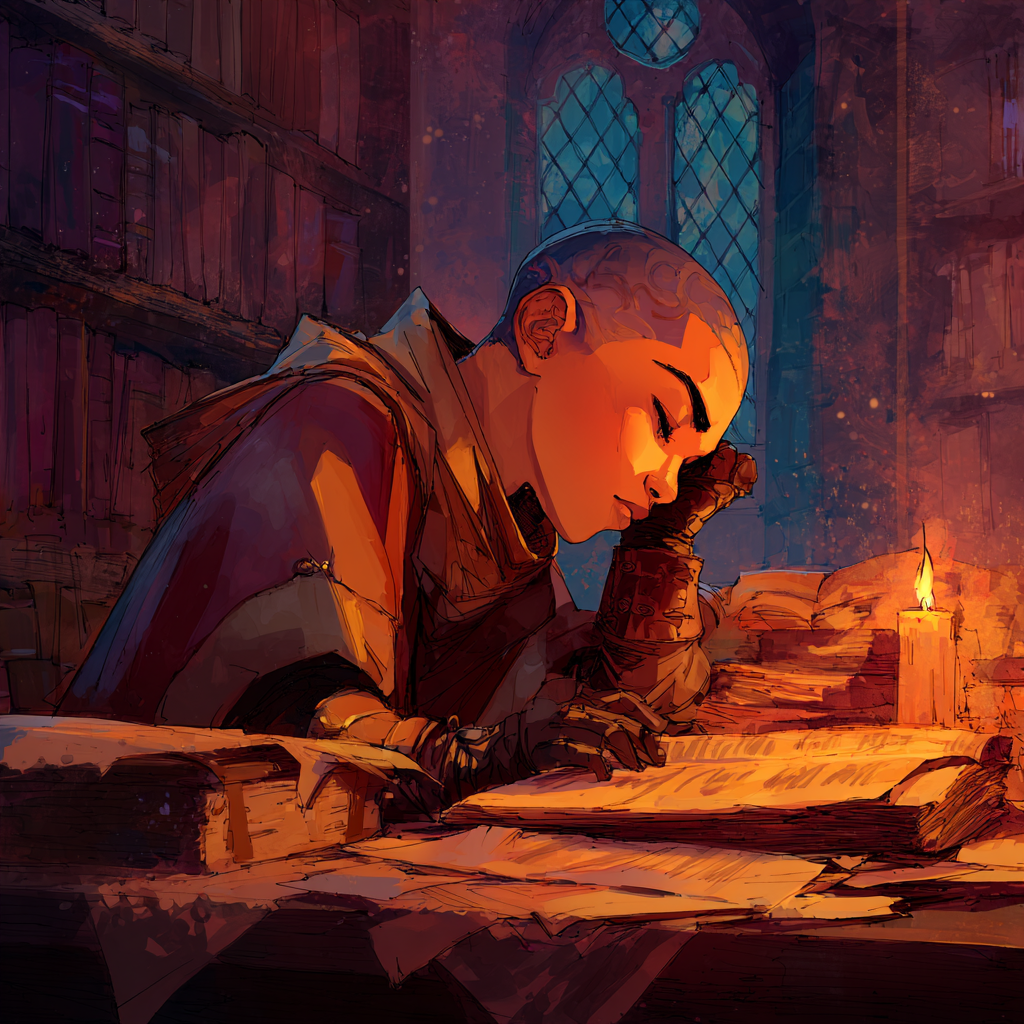
Mama Muni was the university’s librarian. She was forgiving and sweet, sharp-witted and patient. She was a matron to even the older women in the nunnery, and she intimidated all but the most senior men.
Mama Muni kept the university’s vast collection of holy books and ancient truths safe from those not ready to view them. She was the keeper of knowledge.
The younger sisters only called her Mama Muni behind her back. It was Mother Muni to her face, and she encouraged Ruth to explore the teachings of magic and to trust her insights, visions, and dreams. She was the first person on the university staff who did not talk down to the grown woman Little Mei had become.
“A person is wise if, though wanting the best, they examine whether the best is fitting,” Mother Muni had said, and it hung carved in wood above the library’s heavy double doors that opened slowly but slammed shut as if they were spring-loaded.
There were more than three hundred rules for living the life of an awakened woman. These ranged from grooming to dancing to the ones you’d expect about what to eat and what not to eat, what to wear and what not to wear, and of course, stealing and killing and lying, but they also included rules about speaking to men and to monks and other stuff you’d never expect. But the question on Ruth’s lips was what the rules said about self-pleasure.
“Self-what, dear?” Mother Muni held one finger to her ear and leaned toward Ruth.
Muni had been the university’s librarian since the mid-19th century. She had heard all the questions before.
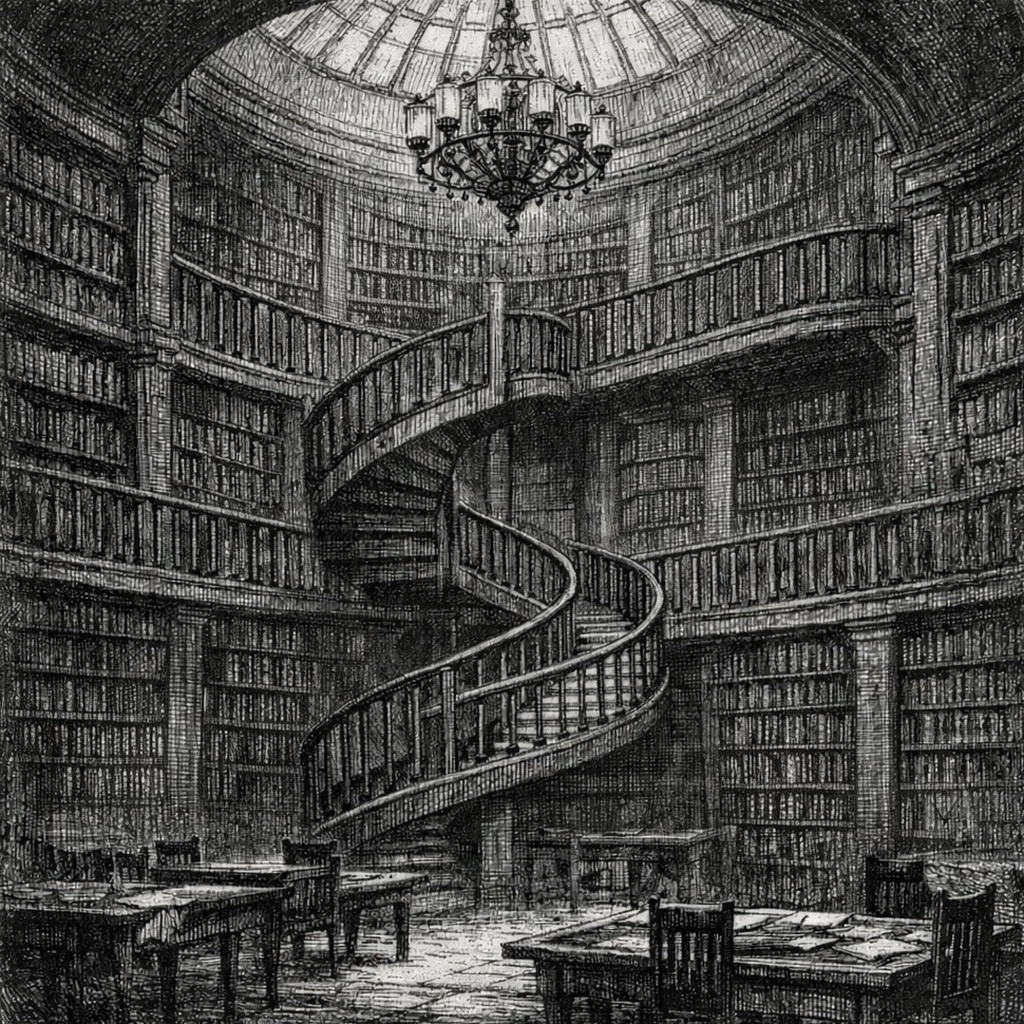
In the library atrium, on the first level of three, with a spiral staircase that spun its way up the center, under a skylight ceiling with a reflective chandelier that offered natural light in the day, moonlight at night, and candlelight when the weather made it necessary. The university held a policy that guaranteed an open exchange of knowledge, and in a library where almost everything intriguing to Little Mei was forbidden, Mama Muni had seen and heard it all.
“I’m looking for something that explains the rules on masturbation in detail.”
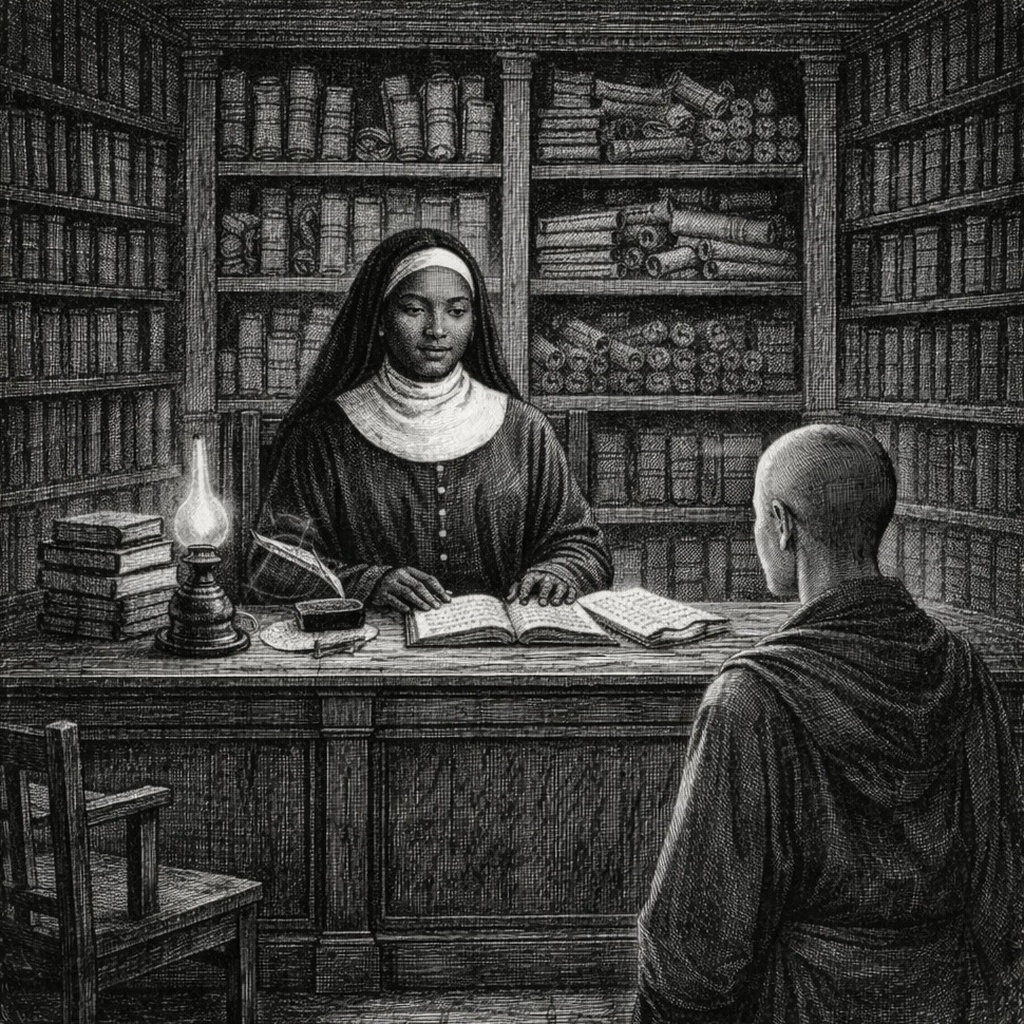
“For monastics?” the Mother asked incredulously.
“Of course.”
“Well, I have books on the rules of sexual conduct by laypeople on retreat and for those who have taken vows.” Mother Muni said coldly. “And you will find them on the third level in the back.” she motioned in the direction with her entire arm, and then she added, “Please refrain from touching yourself while you’re there.” the mother giggled like a woman over eighty with the effortlessness of a girl under eight.
The writings and the rules of sexual misconduct varied from era to era. The ancient scribes were from different cultures and different countries. And even then, the awakened ones’ answers were inconsistent and depended on who had questioned each lord on the subject.
There have been many awakened ones throughout history, but in this context, Mei was going to focus on Jesus and Buddha and then stop, not because these were the two most important but the two that she was most familiar with, and that should be enough.
Shantideva University was one of the oldest centers of traditional knowledge in existence. Famous scholars had passed through its walls. Graduates went on to become teachers, and teachers went on to become legends.
Debaters and meditators of great renown were the institution’s alum. But under the surface, it was also a storehouse of ultimate knowledge accessible to a lucky few Gnostic Christians and tantric practitioners.
Mei’s class schedule included discipline and morality in practice. She hadn’t chosen a domain yet, so she was in what the students sarcastically referred to as a comparative awakened state. She was window shopping enlightenment. There were many ways to become a fully awakened being, but she hadn’t chosen her path.
Mei had an affinity for Christian Philosophy and Debate in the Tibetan tradition. Her guidance counselor recommended she take Zen and Mahamudra Meditation with a focus on mastering the mystic arts.
Mei studied history on her own and audited classes in the physical and natural sciences. She had a full schedule, along with her duties at the orphanage, her assigned monastic chores, and thousands upon thousands of mandatory prayers, prostrations, and recitations.
The university halls were littered with supernatural beings and masters of spiritual disciplines long passed. Mei had a hard time separating the astral from the physical, but that wasn’t her only problem.
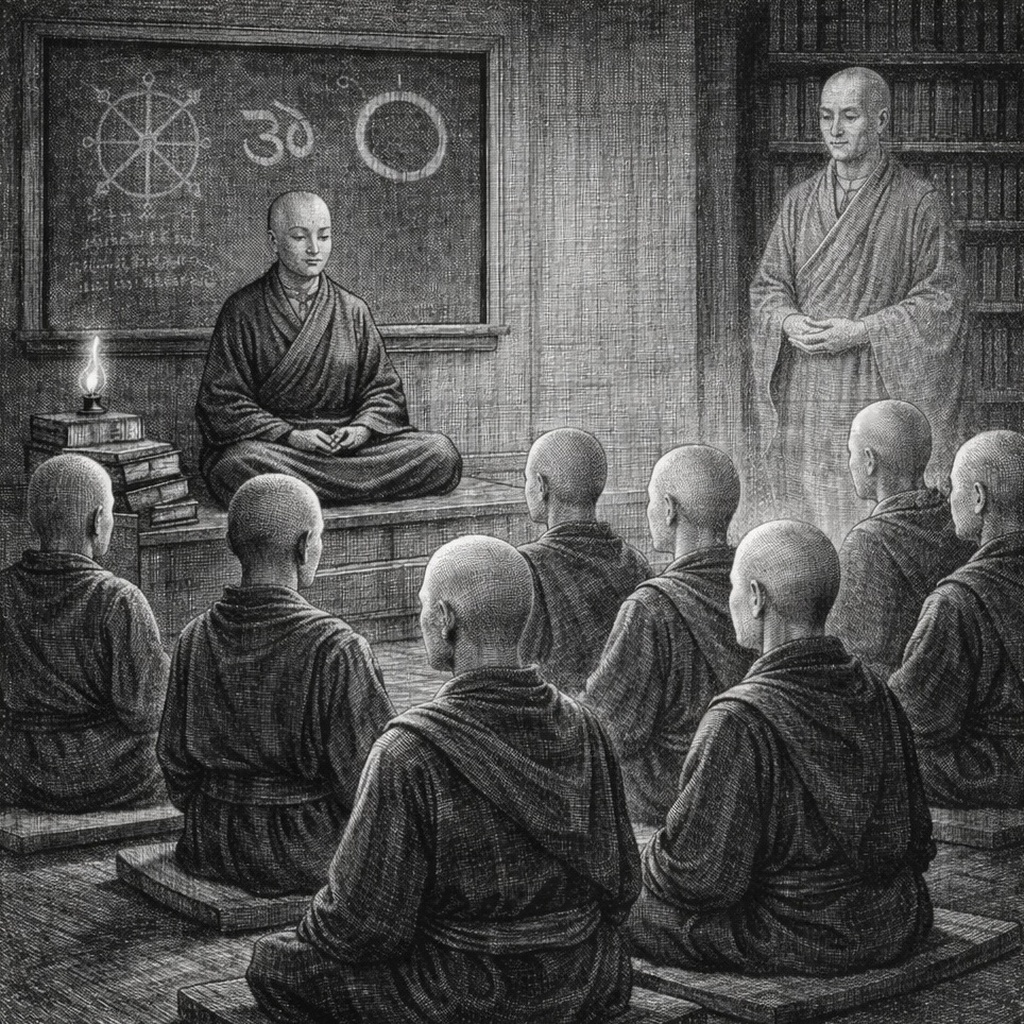
In most classes, there would be a physical instructor who everyone saw and a metaphysical professor only some could see. Both taught the same subject but in very different ways.
During Zen Meditation, her teacher quoted a master named Suzuki, who had died many years before but stood there correcting every word as she spoke.
Mahamudra classes included famous meditators and mahasiddhas seated side by side with classmates and teachers. She could see them all, and there were so many from every realm and every level of existence that occupied the same metaphysical space. She found it difficult to concentrate and needed extra guidance.
The elder librarian met Little Mei’s eyes with compassion for her suffering. “What can I actually help you with, my dear?” she said amusedly.
Mei hardly knew what to say to the older nun as she took in the extensive collection of knowledge with her senses. The great library was quiet, but it buzzed with the anticipation of shared knowledge like an old church bell that still vibrated faintly in the cold air, even after not being rung in years.
Mei felt the peace of what was missing. There was no ethereal being in the library, not one. There was no one here but the living. Mother Muni had a secret.
The mother spoke impatiently. “You must be wondering why there are no souls in here,” she said.
Mei took a long exhale and sighed, “It’s so peaceful. I want to stay here.“

Shantideva University was two schools layered, one on top of the other. Some students attended a conventional school, while others attended a somewhat less conventional one. And it all depended on how sensitive a new student was to the unseen.
The librarian eyed the younger nun worriedly, “You look like you’ve got it bad.”
“I think I may lose my mind.”
“You won’t.” the Mother said with a sly smile. “What you see are pieces of past pupils and teachers who left imprints in the physical and metaphysical space while the rest of their consciousness traveled on to their next iteration. Autonomous echoes of past masters roam the halls.”
“They are everywhere.” Mei continued. “I can’t make sense of it all.”
“You need to narrow your vision,” the mother said. “There is a book about painting. You will find it on the third level in the west wing.” Mother Muni motioned with her arm toward the west wall and then cautioned the novice. “Keep reading the book. Read it again and again until you fully understand it. Do this to the exclusion of all else. A lesson half learned is far more dangerous than total ignorance, and no one else can learn it for you or explain it to you.”
“Wait. Isn’t that where the sex books are?”
“No. There are no books like that in here, young lady,” Mother showed Mei a strange smile that suggested she might be lying. “This is a library.”
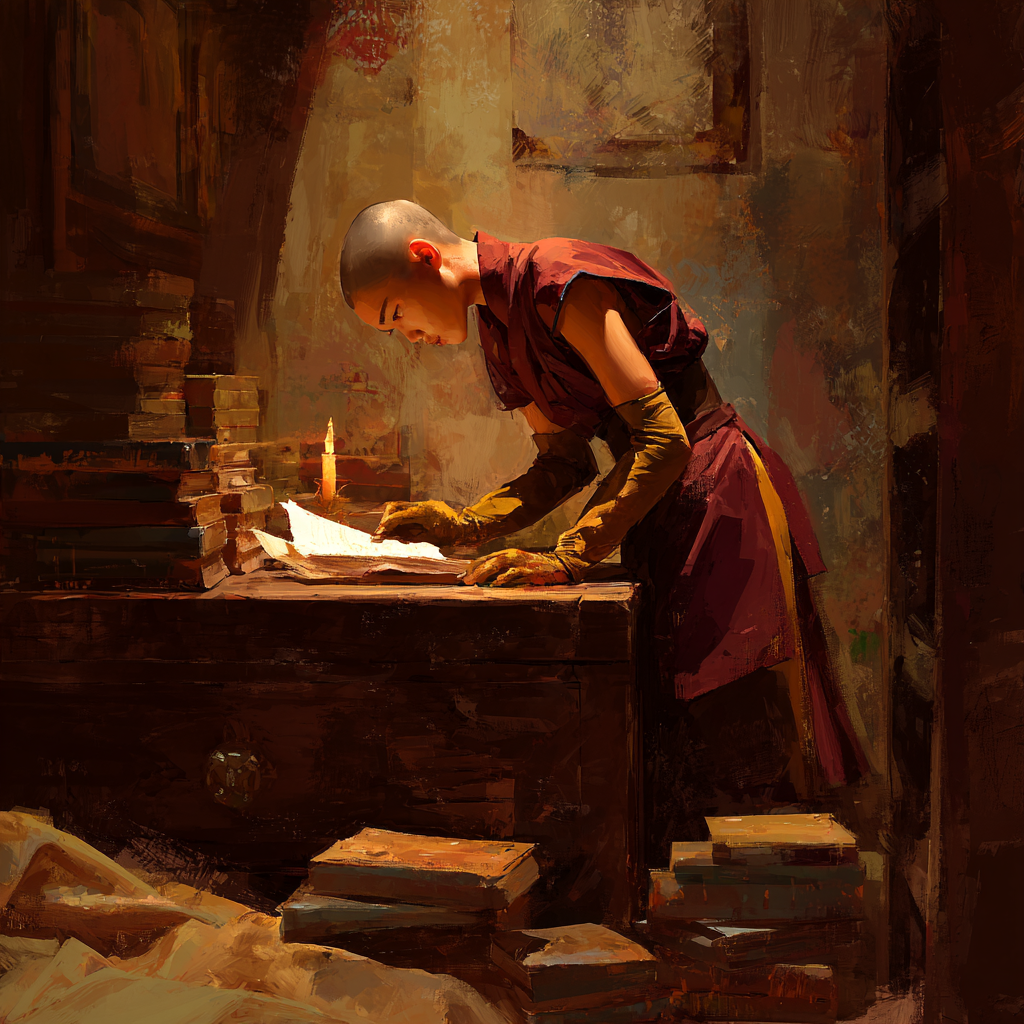
On the third level, in the back, there was a wooden case with no lock. In it was a collection of meditation instructors written by past masters next to a desk and a cot with a blanket. The books were unbound, fragile, and not to be removed from the library. There were thin rubber gloves next to the case.
Mei put the gloves on, sat at the desk, and began to read. She never heard the bells or had to sleep or left to eat. Mei studied the text, and it didn’t make sense in the context of her problem. So she reread it as she had been instructed.
It told the story of a painter who painted over a thousand portraits on one canvas. His mentor had advised him not to paint on a canvas that already held so many images, but he didn’t listen.
He painted one on top of another on top of another. He painted in darker hues to cover the lighter layers and then used bright, vibrant colors on top of the darkest ones.
The book was called The Joy in the Art of Painting Reality, and it spoke in painstaking detail about colors, shades, and tints. The book showed Little Mei how a darker past could be viewed through the pleasant pastel of a present moment or entirely hidden by a brightly colored future. But every time she read it, it seemed to say more in the same words.
Mei believed that it suggested to her that what she was seeing was worlds on top of worlds. She could see realms superimposed over this one. Each with a different hue and a different brightness.
Most people miss the true nature of reality. They can’t see the other realms that occupy our shared space, like an image on top of an image in a photograph. Or a painting on top of a painting on a canvas.
Mei recognized the layers of reality as others did not because she had drawn them. Imprints in time like paint left behind, but only she could know the true picture.

Where others saw empty halls and classrooms, Sister Ruth saw a millennium of past residents—images of past students and the academic imprints of centuries-old professors.
Over the next few years, she discovered she could flip through time and view the monastery’s history through visions of its former occupants, pieces of their essence, and impressions, both lasting and robust.
The first rule of painting your reality was never to talk about it with anyone else. The uninitiated or the unfamiliar could take the spoken word as literal. Actual mystic progress was found by the learned mindful between the truth and the metaphor. It was found between the parable and the paradoxical.
The initiate understood that each esoteric phenomenon existed as the unlabeled center of a Venn diagram of imprecise words and descriptions that had to be turned over in the mind until it could be felt.
Ultimate reality was often coded and draped in regimented and repeated actions to deter the half-hearted from leaving half-learned and destroying their whole world.
Painting reality was a part of her practice that she did not share with anyone. It could negatively affect her peers and younger teachers. They could become disillusioned and jealous. They could foster feelings of hatred and accusations of fakery. It might even inspire others to leave the path entirely— a mortal sin in every tradition.
It was the holy abbot himself that suggested she concentrate her studies on the history of mysticism. She had an uncanny aptitude. She learned to differentiate between ghostly forms and mental impressions. She could see projections from the past and the future.
She learned that being sensitive to the spirit world without wards and protection was like being a magnet to the demons that her guilt created.
Without protection, her unfettered guilty conscience was free to paint punishments for her past mistakes. To put it plainly, she could paint herself into hell without confession, forgiveness, and absolution.
Mei learned to burn frankincense when meditating, along with myrrh and she melted flakes of gold in hot oils to discourage tricksters and demons who could attempt to manipulate her guilt. These tricksters could even drive a practitioner to self-harm. For this reason, in particular, reality painting was only meant to be attempted with trusted guidance.
Sister Ruth chuckled at the thought of suicide. She had too big of an ego to deny the world even a moment of her presence.
Her reality practice worked to slowly lessen her ego grasping while, simultaneously, she was being saved by it.
These were secrets hidden in a book about painting. Only after it was misunderstood could it be learned. It was a delicate and critical balance that felt like walking a tightrope made of sand.
Over the next several years, she learned to project her astral body during sleep through consistent reading, instruction, and practice. She visited places as far away as she could imagine—countries and continents. Her meditation teacher told her that time was not a factor in her travel and that she could also visit other sites at different eras throughout history. She learned that her movement through space or time was the same discipline. The only difference was her mind.
With a multiverse of other realms that opened up to her, Sister Ruth looked forward to her sleeping hours. She had found freedom in her dreams. Her sisters would call her lazy for how much time she spent sleeping, but she never cared much for what others thought or the box they placed her in. She would eventually learn to walk through walls while awake, and when she did, no prison would hold her. ||
Read another story → · See all of Melvin Horton’s stories →
Share this:

I occasionally say interesting things. Sign up for the newsletter →
Comments are closed.