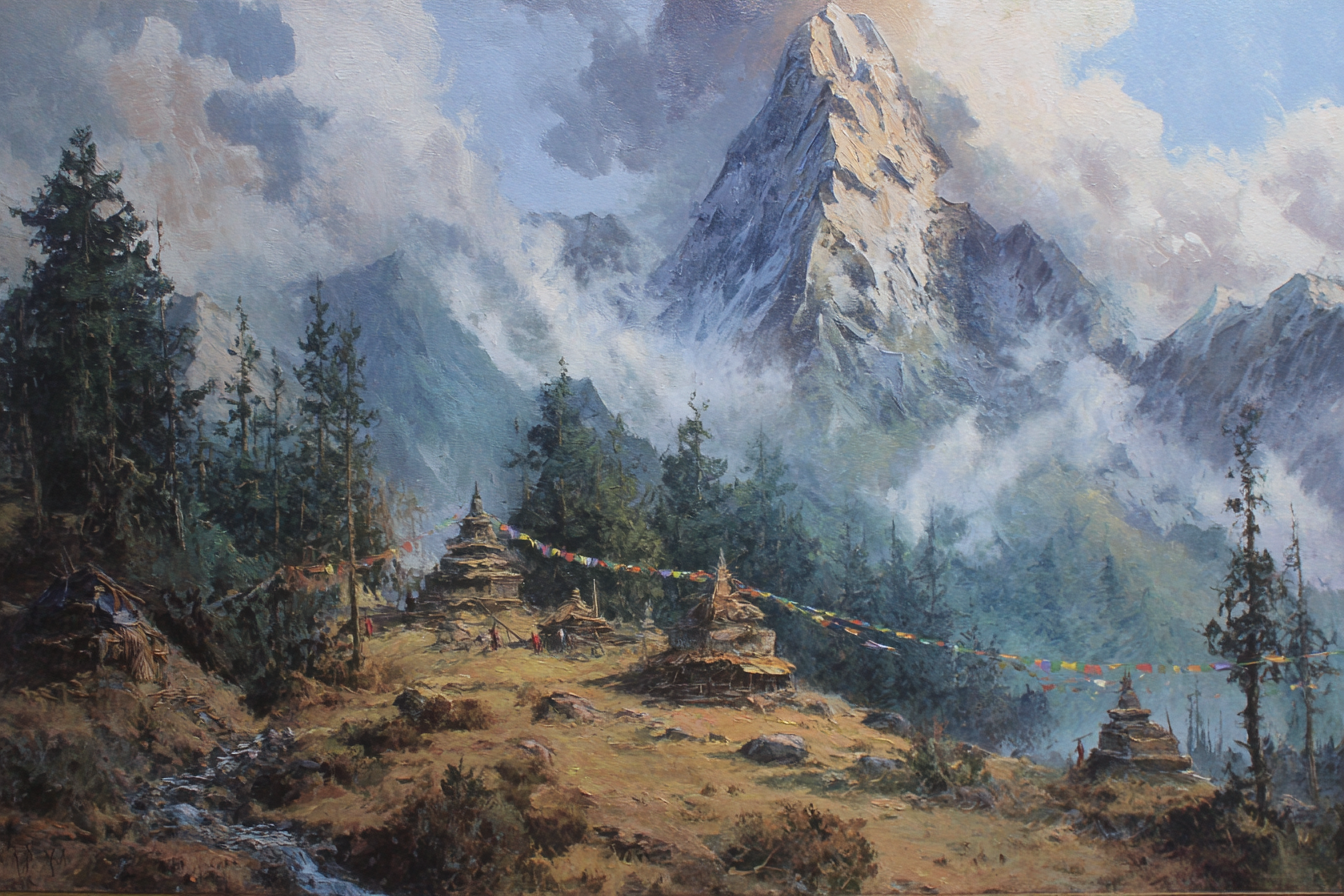
Mother Ruth and eleven of her most senior meditation students set out on an extended wilderness retreat in the mountains and forests far away and high above the monastery, the nunnery, the hot and cold running water, and the university’s fully stocked kitchen.
The mountain held a place of reverence for the locals. They say when its peak disappears into the clouds, into a realm where the air remembers every sacred word, prayer or magic incantation, that the tiny tip at the top can somehow support everyone on the island, the world, the universe. Mount Meru, they called it. It was a good story.
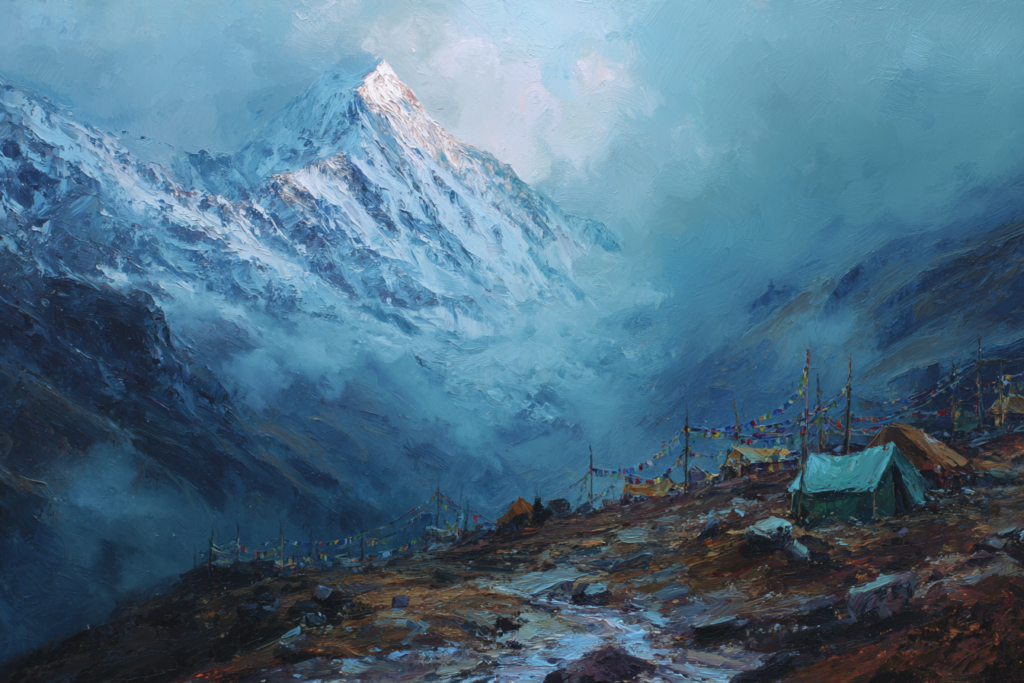
After four weeks of living in tent-like shelters on the lonely mountainside, Mother Ruth had finally acclimated to the isolation of an intense meditation retreat. Yet, it was the sudden drop in temperature that happened every evening after sunset and the stunningly oppressive heat in the middle of the day that made the elder nun and her students doubt they could ever survive another thirty-six weeks.
After week twelve, each nun rebuilt their shelters deeper in the forest, near groves of wild berries and a stream of fresh water but far enough away from the other women so as not to fight over resources. They would see very little of each other before the retreat was done. This was done to foster isolation and separation but remain close enough for the safety of numbers.
Their summer dwellings were modest, patched together with mud and leaves, open enough to breathe but covered enough to remind the practitioners that nothing was more permanent than the brutally hot summer sun. And it, too, was temporary.
Then the autumn came and the mountain’s warmth pulled up stakes and left for the winter. So the women dug deeper pits for their fires and hunkered down for the winter weeks, and none but the weakest among them complained, because naming your suffering only made it worse.
Mother Ruth was the senior nun on site but these were not novices. A meditation retreat of this length required strength of will and patience with adversity. A weak mind could snap under weeks of pressure or harden into a diamond, or expand into the space provided.
Schizophrenia is what they label it when someone other than a saint hears voices, or sees the images of ghosts in their kitchen.
Ebenezer Scrooge had a schizophrenic episode after being racked with guilt for denying his best employee time off or a Christmas bonus. The man had a disabled son, and Ebenezer pretended like it didn’t bother him, but it did. Enter Marley’s ghost and his time-traveling trio.
When a religious practitioner or a saintly person hears voices or sees phantoms, it is not labeled as psychotic in retrospect. Instead it gets called communion or visitation. It is a miracle and a sign. The only difference is guilt.
Ebenezer saw demons and tormentors who helped him in the end, but only because he had Marley as a guide. Those other three ghosts out of context would have driven him insane.
The practitioner, we hope, would have done the work of purification beforehand. It’s the forgiving of past mistakes through confession and ritual, the mindfulness of recognizing regret and remorse as real that prepares a student to see the lies she tells herself. She thinks she’s ready but she isn’t. She thinks she’s a saint but her sin still burns. And that, my friends, is when the friendly ghosts become not so friendly demons. Tormentors instead of teachers.
Mother Ruth, after a dozen weeks of meditation, was visited by three ghosts. They were the ghosts of mahasiddhas past. Four ghosts if you count Milarepa. He was like the Marley of the group but without the chains.
MILAREPA
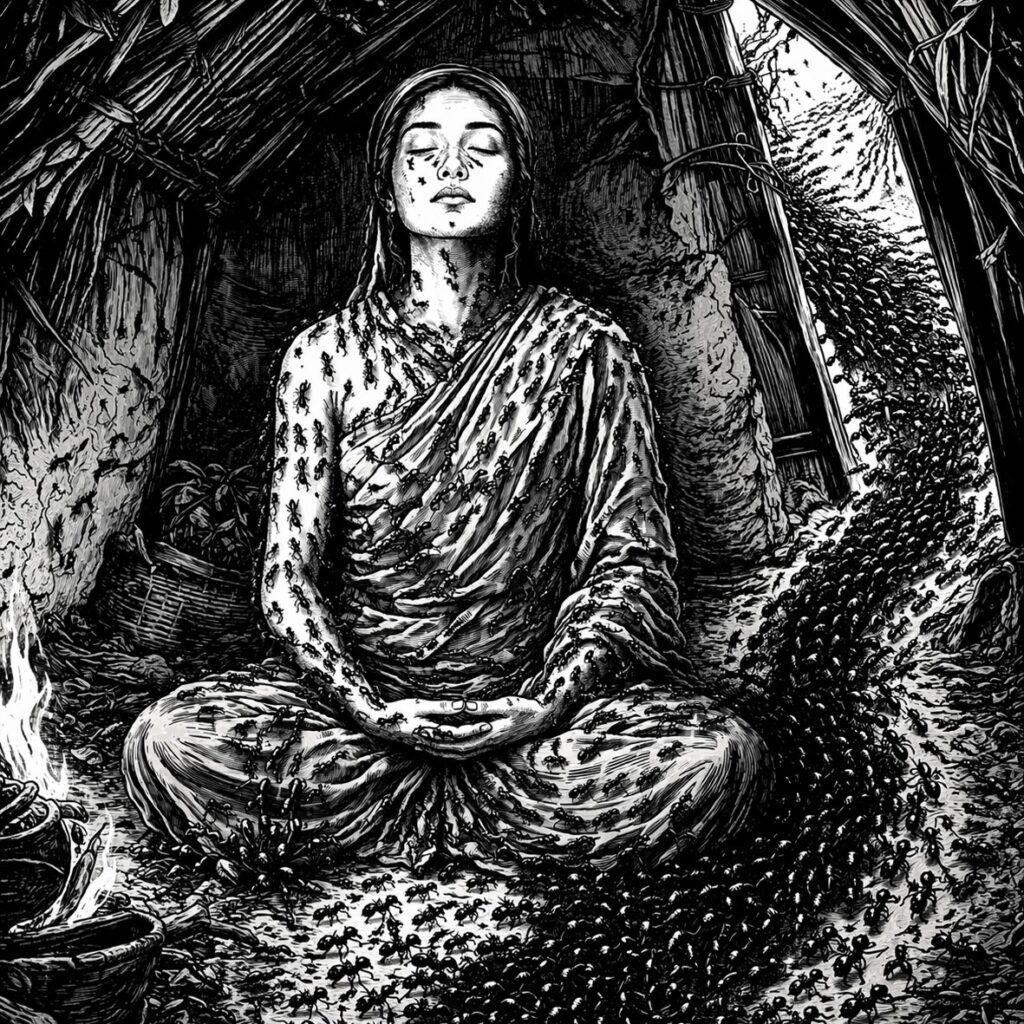
The first to visit was the great Jetsun Milarepa. He entered her tent with a swarm of insects.
Ruth had heard the tiny creatures crawling into her shelter by the hundreds with her eyes closed because nothing went unnoticed, but she was undisturbed. Only when the ants began to bite into her skin, did her focus waver.
Mei never cared much for insects. Beetles and ladybugs frightened her when she was small because they were so much smaller than her. She feared she might step on them. However, ants angered her greatly whenever they bit her like these did.
Little Mei would not have been able to sit still for their meal and yet Mother Ruth did.
The bugs crawled on her and bit her, and, to her astonishment, she did not react. Instead, she imagined herself as a ready-made dinner for the tiny sentient creatures. She imagined her humility as the perfect balance to her self-cherishing pride.
She transformed her anger into the resolve not to harm even one insect. She kept her concentration and stillness carefully so as not to shift even a little in her seat, or else she would disturb the insects’ repast.
For Mei, being covered in insects was her ultimate nightmare, but Mother Ruth was happy that it was her and not her sisters being infested. She would gladly be the insect’s dinner instead of any of the others because she was strong enough to accept it. She would offer her body to the insects, and she would offer her strength to the other sisters.
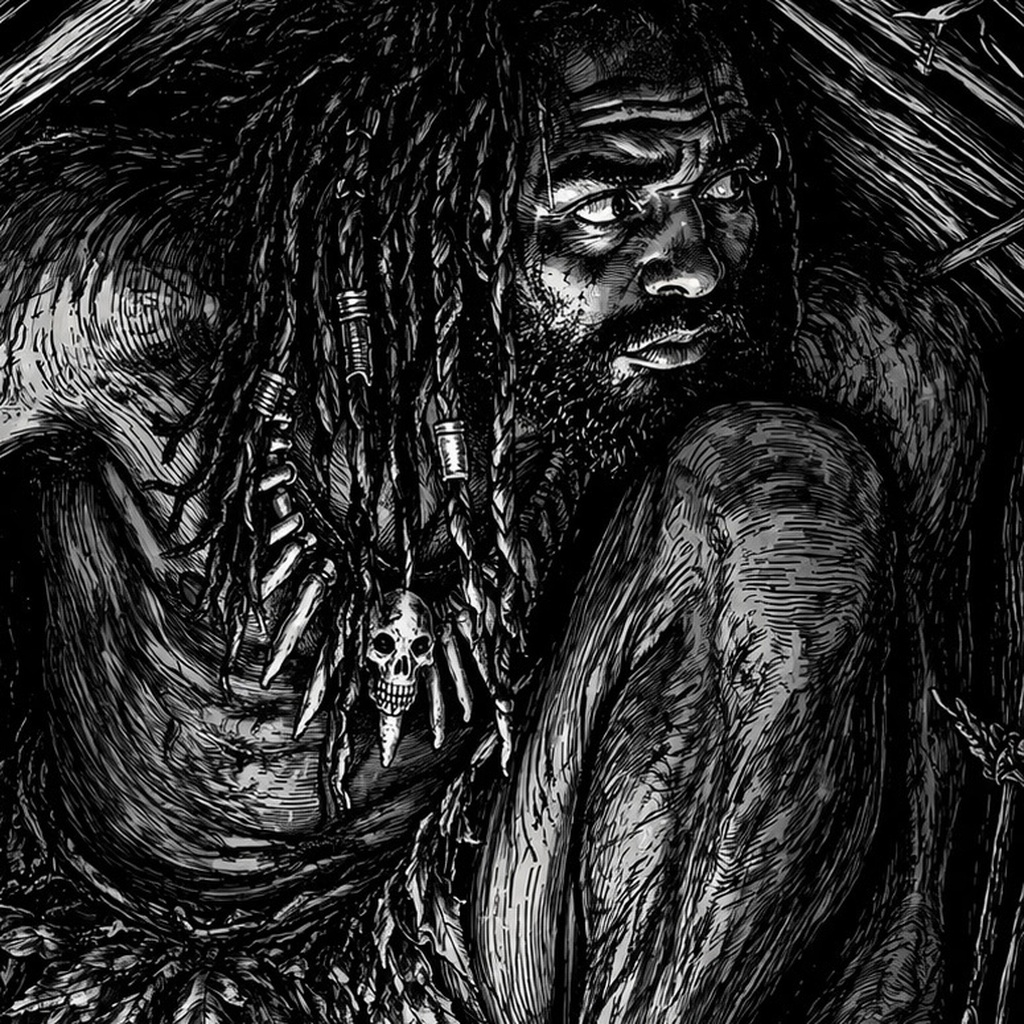
A dark-skinned man with long black-knotted braids and frayed, dirty, and matted locks appeared beside her, crouched inside her tiny shelter. There was barely enough room for her, yet her tent accommodated this large man and his wild hair.
It was a tight fit. They were close together but never touched. He did not appear as an ethereal being. He was flesh and bone. She could feel his breathing, the heat from his body, and the stench of his manhood.
Milarepa appeared to Ruth as a wild caveman, a relic of the human species. He was naked, excepting leaves covered in mud and a necklace of bones. He was both overly nervous and eerily calm at the same time. His body shook with a vibration that was constant and soothing.
Milarepa was physically imposing, long and wide, with eyes that darted back and forth around Ruth’s little shelter in the firelight. He crouched above her on one knee with the soles of his feet pressed together awkwardly, never once resting his eyes on her face or meeting hers.
He was a hairy man who took up most of the space available but left her just enough to avoid skin contact, and Ruth made herself small to accommodate him.
When Milarepa spoke, he sounded like a little man with very little confidence and yet he was a giant with a poet’s vocabulary—a bohemian behemoth from a distant past.
“If you’re not careful, these creatures will devour your ego,” Milarepa told her, referring, she believed, to the insects.
“An army invades from the north,” he told her. “They will use up all your resources and then vanish because that’s all you ever were, a juicy resource for a limited time.”
“That’s all any woman is,” Ruth responded. “To the world of men and the world of insects alike,” Ruth spoke with confidence. “What can I do for you, great master?” she asked him.
“I need nothing,” he replied like an insolent baby. “I seek nothing. I desire nothing,” he said.
When she opened her mouth to respond again, he quickly turned his head away, hiding his face from her words as if they were arrows or acid and meant to hurt him. She closed her mouth quickly, and he continued.
“I have no desire for wealth or possessions, and so I have nothing.” He offered her his words.
“I do not experience the initial suffering of having to accumulate possessions,” he said. “Nor the intermediate suffering of having to guard and maintain those possessions, nor the final suffering of losing those possessions to time and circumstance.”
He completed his offering of words, and Mother Ruth smiled at him, and he smiled back like a child receiving praise from its mother.
Milarepa bowed to the swarm of tiny creatures with reverence as if they were his precious teacher or a holy relic, but he ignored their living meal as if she were insignificant.
Perhaps the words were for them because they all stopped eating and stopped biting the body of Little Mei and crawled quickly from the shelter and back into the forest.
Milarepa was a peasant before he found a teacher—a peasant who had committed numerous crimes.
Before accepting Milarepa as his student, his teacher, Marpa made him build houses from raw materials. Then, once he had finished, Marpa would make him tear down those houses and start again.
Milarepa would make them bigger and better each time. And each time, Marpa would order him to tear them down again. Block by block. Piece by piece. Bit by bit.
Milarepa knew this was a test, so he expended maximum effort every time, learning new and creative ways to make the finest houses ever built by one man, only to be ordered to destroy them and scatter the pieces to the ground each time.
This went on for years, and Milarepa did whatever was asked without complaint because he wanted to show Marpa that he would be an obedient student. But the effort and time it took to build house after house, and the callousness with which Marpa treated him and his work, made Milarepa begin to doubt himself.
He had nothing left. He began to think that Marpa would never accept him as a student and that he would never gain the secrets and realizations that could come from being the disciple of a great teacher such as him.
Milarepa was near suicide, crying and sad when Marpa finally accepted him as a student. Marpa had broken down what was left of Milarepa’s ego, his spiritual pride, and the attitude that he deserved to be Marpa’s disciple. It had been replaced by openness and a willingness to accept whatever the great teacher had in store for him.
“Was it a test of your faith?” Ruth asked him.
“He who knows that all things are his mind,” he paused. “That all things,” he continued switching pronouns. “with whom she meets are friendly, is ever joyful.”
Ruth smiled as Milarepa switched the pronouns even as he never acknowledged her.
She had learned about Milarepa at the university and heard about his songs as a child. She had thought that he’d gone insane in his cave retreat. He talked to animals, insects, and demons. He wrote songs of realization. And he spent hours in deep meditation. He was known as a master meditator.
“All meditation must begin with arousing deep compassion,” he told Ruth as if reading her thoughts.
“Whatever one does,” she added. “must emerge from an attitude of love and benefiting others.” she finished, quoting him to him. “But is compassion enough?” She asked.
“Do not entertain hopes for realization, but practice all your life,” he warned her.
Milarepa and Ruth Lubaba were swiftly transported to a pure land where he shared with her his life lessons.
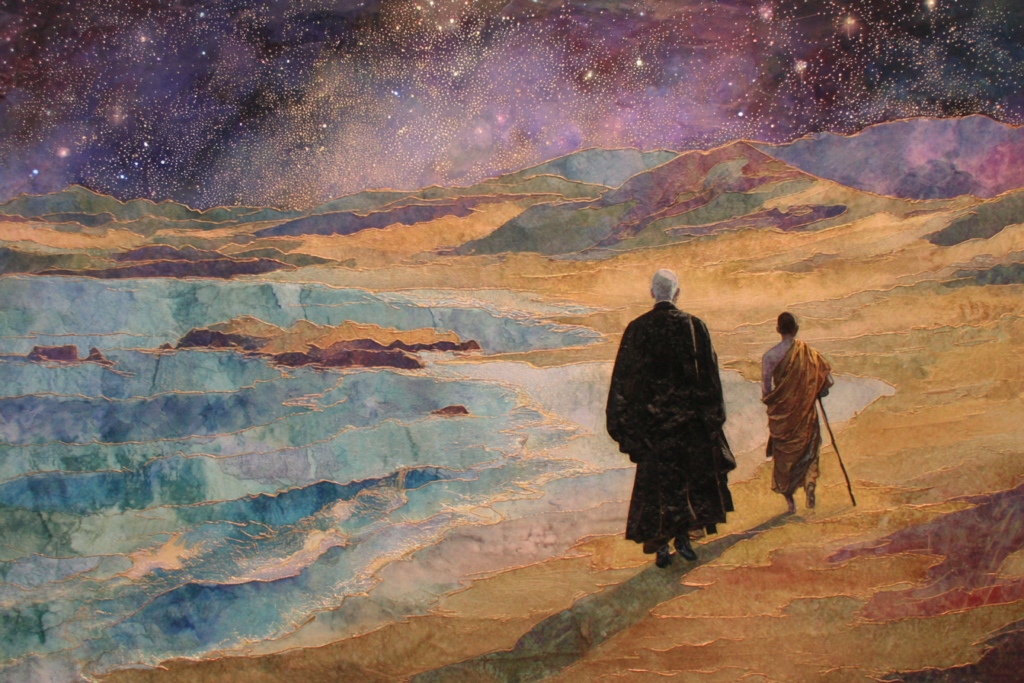
They walked along a shoreline where crystal blue waves glided across soft beige sand beneath a sky full of stars on a bright blue sky.
They walked along a shoreline under rolling hills and a wide-open valley. Vibrant, beautiful colors unlike anything in the natural realm, filled in physical details of peaceful, calm existence on this pure land.
There was no fatigue. No concentration. No fear, pain, or confusion. No bliss or attachment to pleasure. There was only pleasant serenity and company.
They walked silently, taking in the picturesque scenery and pleasant surroundings. There was no awkwardness and no desire to fill the silence with questions until she felt the moment was right to break into song.
“They say you spoke to demons and were visited by sirens, enchanters, witches, and beautiful goddesses. Did you go mad?” she questioned him.
“What is sanity when the sane see illusions as reality? What is madness when the mad see the true nature of things,” he mumbled. “Strong and healthy, who thinks of sickness until it strikes like lightning?”
“Expect the unexpected,” she said.
“Preoccupied with the world, she thinks of death until it arrives like thunder?” he continued.
“You lived on grass and the water that dripped from the ceiling of your cave,” she remembered from her studies.
“Life is short, and the time of death is uncertain, so apply yourself to meditation, Mother.”
“And what of the time, I’m not meditating? What should I do then?” she asked. “What did you do?”
Milarepa spoke confidently. He said, “Avoid doing evil and acquire merit to the best of your ability, even at the cost of life itself. Act so you have no cause to be ashamed of yourselves and hold fast to this rule.”
They walked further down the shoreline but got no closer to the hills. The hills were the perfect distance away at all times. The light was at an excellent illumination level, and the surface seemed connected to her heart.
“I wrote poetry,” he answered her question. “Accustomed long to contemplating love and compassion….”
She interrupted him, saying. “I know this one.” She quoted him again, “I have forgotten all the differences between myself and others.” She stopped herself before becoming proud of her memory, instead reminding him. “You sang songs to the trees.”
Milarepa stopped suddenly and turned his face to her. He looked Ruth in the eyes for the first time and said. “My religion is not deceiving me,” he said, transferring more than words with his eyes. His eyes showed pride in her accomplishments and hope for her future.

“Did I pass the test?” she asked him.
“All worldly pursuits have but one unavoidable and inevitable end, which is sorrow.” He answered somberly.
“Well, that’s depressing,” she said as he began to yell.
“Acquisitions end in dispersion!” he hollered. “Buildings end in destruction!” he yelled to the horizon.
“You’d know all about that.”
“Meetings end in separation. Birth ends in death,” he said calmly to the ground and the earth.
“Yes.” she agreed.
“Knowing all this,” he touched her shoulder. “We should renounce acquisitions, and building, and meeting, and storing up,” he said. “And set about realizing the ultimate truth.”

Milarepa pushed down slightly on her shoulder as if commanding her to stay and he walked up the beach to the distant hills that moved closer as he moved further away.
“It’s not about religion, then?” Ruth asked.
“Realizing the truth alone is the greatest practice of religious observance,” Milarepa said. With that, he disappeared, leaving her in that pure land realm with the quiet buzz of their passing conversation.
Ruth stayed, and it was fun for a while. She enjoyed the land but then thought of her retreat and the suffering of her students. It would be impolite to her sisters if she stayed in this pure land while they suffered in the wilderness, so she returned as if awakened by the chapel bell for breakfast.
She remained in seated meditation, contemplating the encounter, for several days until she emerged from her shelter to bathe, gather berries and nuts, and return to her tent.
Milarepa told Ruth that his teacher, his teacher’s teacher, and his teacher’s, teacher’s, teacher would visit. An unbroken spiritual lineage that would each come to her aid when she was ready.
He told her that each teacher’s teacher would help her master mental and physical disciplines. They would appear at her lowest moments, but only once she had recognized those low moments as also her highest. They would appear when her suffering was unbearable but only when she recognized it as perfect bliss.
It was another eight weeks before she got another visit. It was the Mahasiddha Marpa, and he arrived with the autumn chill. ||
Read another story → · See all of Melvin Horton’s stories →
Share this:

I occasionally say interesting things. Sign up for the newsletter →
Comments are closed.